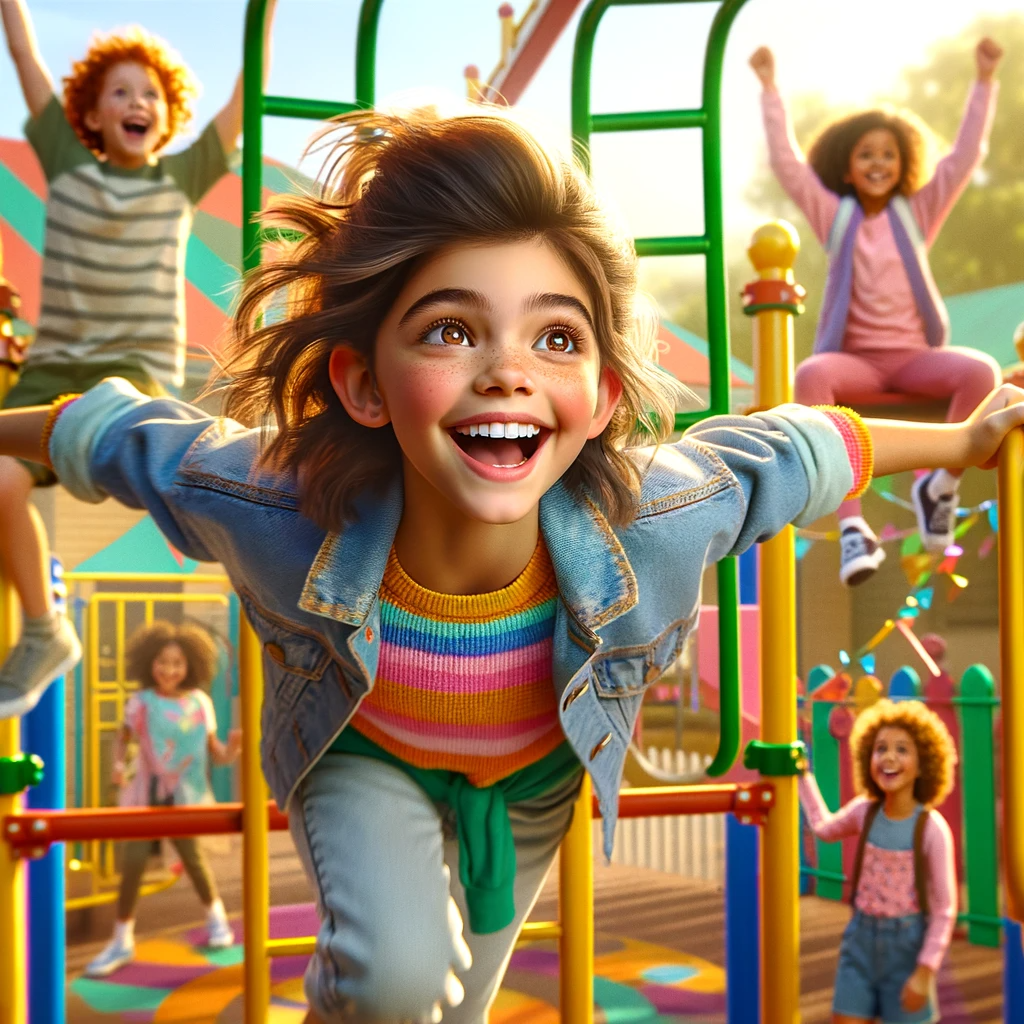
In a bustling neighborhood playground, a group of inventive children, led by a quick-witted girl named Ellie, are deep in an imaginative game. Ellie, renowned for her unique word creations, triumphantly completes a daring feat on the monkey bars, drawing cheers from her friends.
In a burst of excitement, she exclaims, “I just did a skooglyplat!” This spontaneous term instantly captivates her friends, who begin using it to describe anything remarkably good or impressive. “Skooglyplat” soon becomes synonymous with fun, excellence, and childhood joy.
The word spreads through the school and beyond. Teachers and parents, tickled by its quirky sound and positivity, adopt it into their language. A local writer, charmed by its originality, features “skooglyplat” in a children’s book, catapulting it to widespread fame. It permeates media, appearing in TV shows and news segments, and even makes its way into cartoons. Gradually, “skooglyplat” crosses cultural and linguistic boundaries, universally signifying excellence and achievement.
The children grow up, but “skooglyplat” grows with them. In high school, it becomes a chant for sports teams and a symbol of encouragement. Valedictorians use it in graduation speeches to evoke the spirit of success and youthful creativity. As adults, these individuals infuse “skooglyplat” into various fields, from business to art, where it comes to represent innovation, creativity, and a nostalgia for simpler times.
Decades pass, and “skooglyplat” becomes a cultural staple, a word that encapsulates an era. Parents who were once those playful children at the playground now tell their kids the story of how “skooglyplat” came to be, instilling a sense of wonder and the importance of imagination.
Meanwhile, at another playground in a distant city, a new generation of children plays under the sun. Among them is a young boy with a vivid imagination, much like Ellie years ago. In a moment of triumph after skillfully navigating the jungle gym, he shouts out a word that springs to his mind: “Zibberzoom!” His friends, intrigued, gather around, asking what it means.
With a confident smile, the boy declares, “Zibberzoom means doing something so cool, it’s out of this world!” The word instantly resonates with the group, and just like “skooglyplat” years before, “zibberzoom” begins its journey from the mouths of imaginative children to the wider world. The cycle of creativity and linguistic evolution continues, a testament to the power of play, imagination, and the enduring legacy of childhood wonder.
The Philosophy of Gibberish: The Evolution of Meaning in Human Language
Although random sounds can cause great confusion, as the clip from Billy Maddison demonstrates – the theoretical concept of gibberish, often dismissed as nonsensical or meaningless speech, holds significant philosophical and linguistic implications. It underscores the fluidity of language and the human capacity to ascribe and alter meaning to the sounds we produce. What exactly is the philosophy of gibberish? How does it highlight how humans imbue sounds with meaning, the potential for meanings to evolve, and the complexities arising from linguistic evolution?
The Nature of Gibberish
Gibberish is typically characterized as a string of sounds that mimic the rhythm and intonation of language but lack conventional semantic value. It demonstrates the arbitrary relationship between signifiers (sounds) and signified (meaning). This arbitrariness is a fundamental concept in linguistics, as noted by Ferdinand de Saussure, a pioneer in the field (Saussure, 1916). Gibberish, in this context, serves as a stark reminder of the inherent subjectivity in language construction.
Ascribing Meaning to Sounds
Humans are unique in their ability to assign meaning to specific sound patterns. This process begins in infancy, as children learn to associate sounds with objects, actions, and concepts. Studies in language acquisition, such as those by Noam Chomsky, suggest an innate human propensity for language, implying a natural inclination to seek meaning in sound (Chomsky, 1965).
The Fluidity of Language
Language is not static; it evolves as societies and cultures change. New words emerge, old words fade, and meanings shift. This evolution is well-documented in historical linguistics. For example, the word “awful” once meant “worthy of awe” but has shifted to a negative connotation (Oxford English Dictionary). This fluidity illustrates how language, much like fashion, can change its ‘clothes,’ adapting to the times and contexts.
Miscommunication and Differing Perspectives
One of the more intriguing aspects of linguistic evolution is the potential for misunderstanding. As meanings change, communication can become a complex dance of deciphering intended meanings. This is particularly evident in cross-generational or cross-cultural interactions, where the same words may hold different connotations. The philosopher Ludwig Wittgenstein’s theory of language games (Wittgenstein, 1953) highlights this, suggesting that words derive their meaning from their use in specific forms of life, leading to varied interpretations.
What do you think?
The philosophy of gibberish, far from being an area of frivolous speech, offers profound insights into the nature of language and communication. It exemplifies the human capacity to create and alter meaning, reflects the dynamic nature of language, and sheds light on the complexities of human interaction when common terms evolve over time. Understanding the fluidity of language and the potential for varying interpretations is crucial for effective communication and appreciation of the richness and diversity of human languages.
References
- Saussure, F. de. (1916). Course in General Linguistics.
- Chomsky, N. (1965). Aspects of the Theory of Syntax.
- Oxford English Dictionary. Entry on “Awful”.
- Wittgenstein, L. (1953). Philosophical Investigations.
Join in the Conversation
Join us in a vibrant discussion on the story of ‘skooglyplat’ and the fascinating philosophy of gibberish. Dive into the creative and adaptive aspects of language evolution and share your views on this dynamic process. Let’s tackle together the challenges of miscommunication in an ever-changing linguistic landscape – how do you navigate these shifts in meaning? Most importantly, contribute your perspective on how language shapes our reality and understanding of the world. Engage, share, and be part of this enriching conversation about the intricate dance of human communication and its impact on our lives.



 Does God Exist?