
In the heart of a vibrant meadow, Chicken Little’s urgent cry shattered the tranquility: “The sky’s falling!” His eyes, wide with terror, mirrored the fears of his unlikely companion, the Boy Who Cried Wolf, now a grizzled man, his staff a silent witness to their shared obsession.
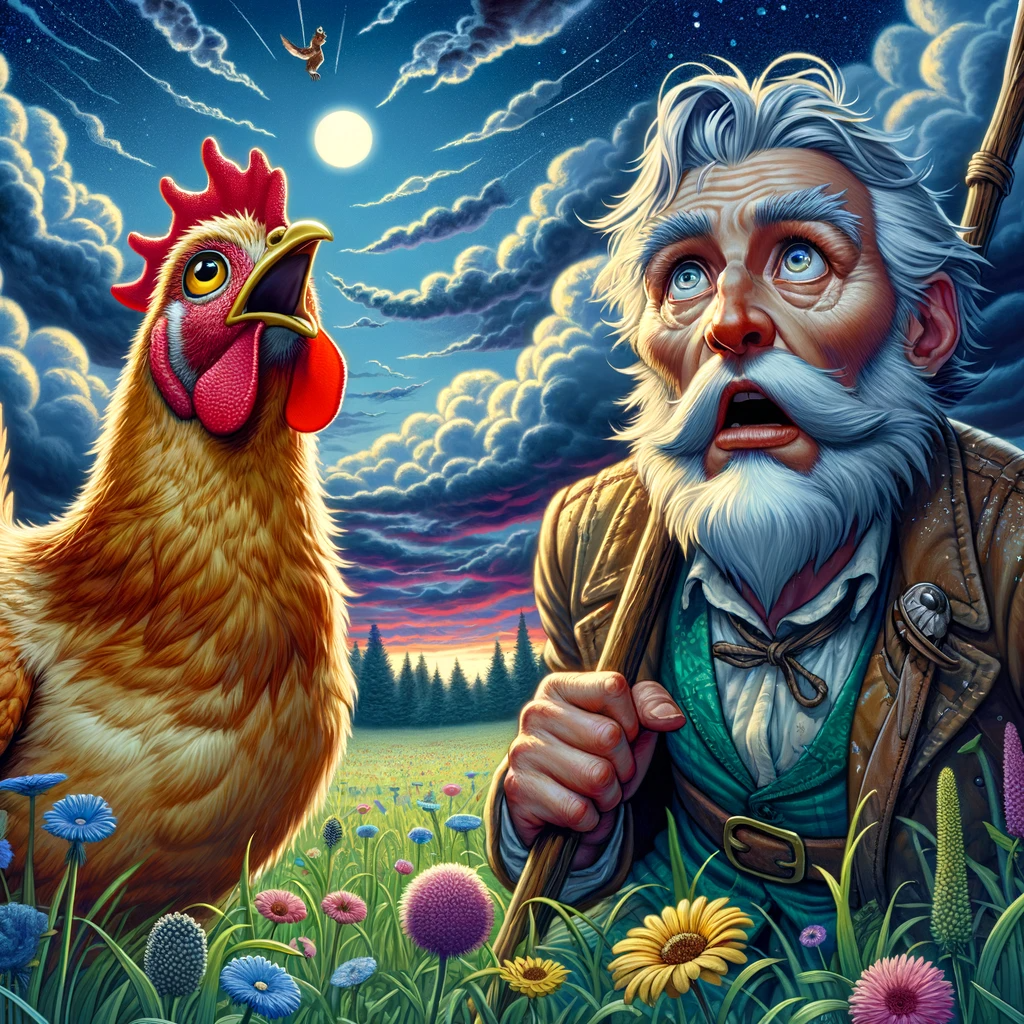
This duo, bound by childhood warnings dismissed as mere fantasy, had spent their lives under the watchful eyes of villagers who had long since turned their worries into jest. Each whisper of wind, each shadow from the clouds above, sparked their alarm, a relentless echo of dread that had woven itself into the fabric of their lives.
As the years unfolded, Chicken Little and the Boy Who Cried Wolf navigated a life colored by their unshakable belief. Their childhood warnings, initially the source of amusement and curiosity, gradually morphed into a heavy cloak of obsession that draped their every action. With each passing season, they aged, their feathers and hair graying under the relentless weight of a sky they believed to be on the brink of collapse. Villagers watched as the pair transformed from wide-eyed youths into figures of weary resilience, their once-lively steps slowing, yet never ceasing their vigilant watch. Despite the skepticism that greeted their every proclamation, they could not, and would not, shake the deep-seated fear that had anchored itself in their hearts.
This singular focus strained their relationships, leaving them isolated, save for each other’s unwavering company. As they neared the end of their days, their fervent belief never wavered. On their deathbeds, with voices as frail as their bodies, they imparted their fears and convictions to their children. With a mix of reverence and solemn duty, these new bearers of the legacy listened intently, accepting the mantle that had defined their forebears’ existence. In their final moments, Chicken Little and the Boy Who Cried Wolf gazed one last time at the sky they had so feared, their last breaths whispering warnings of the impending doom they would never witness.
Decades blended into centuries, and the legacy of Chicken Little’s and the Boy’s alarms was inherited like a curious heirloom, passed down through generations. Their descendants, born with a keen sense of impending doom, honed their instincts in a world that remained ever skeptical. The villagers, though weary of these perpetual warnings, harbored a subtle, unspoken doubt, their eyes occasionally darting skyward with a flicker of uncertainty. Yet, life flourished under the stubbornly unyielding sky, the sun rising and setting in a comforting rhythm, the seasons painting the meadows in an endless cycle of renewal.
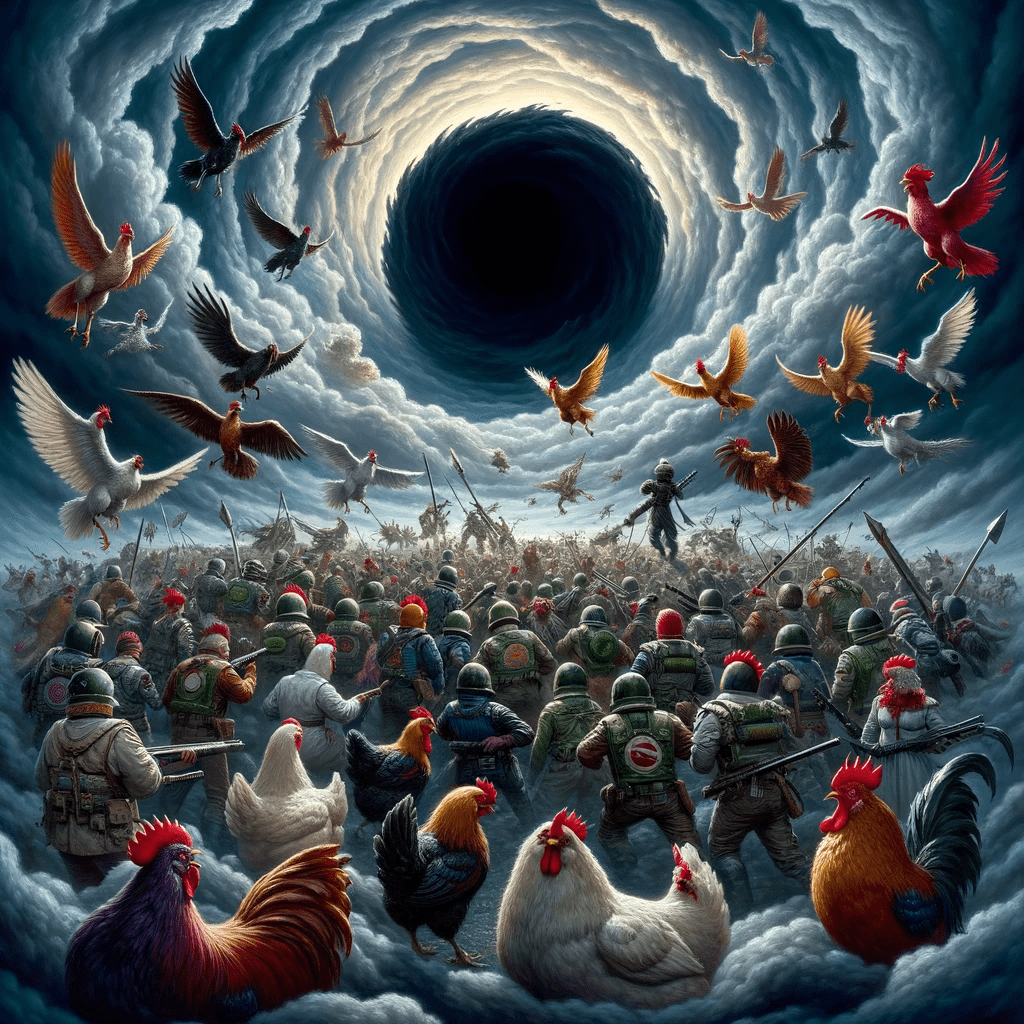
Suddenly, 10,000 years into the future, an unexpected tremor rippled through the earth, a sinister prelude to the unfathomable. The familiar sun, a beacon of constancy, was eclipsed by an ominous, encroaching shadow that chilled the soul. A primal, eerie howl, alien yet familiar, resonated across the landscape, heralding the arrival of a creature born from the darkest recesses of fear. Its form, a swirling mass of darkness with eyes like abyssal pits, tore through the very fabric of the sky, rendering the age-old warning into a terrifying reality: “The sky… the sky is truly falling.”
In this moment of existential crisis, the descendants of Chicken Little and the Boy Who Cried Wolf emerged as unexpected champions. Their lineage, shaped by generations of caution and alertness, equipped them uniquely for this unprecedented challenge. They orchestrated a desperate yet methodical evacuation, leading the once-skeptical villagers to meticulously prepared shelters, their actions a dance of survival honed by centuries of mock drills and planning. Meanwhile, the Boy’s kin, with senses sharpened by a legacy of vigilance, tracked the creature’s every move, their strategies a testament to the power of preparedness in the face of the unknown.
As the final battle against the dark entity raged, a spectral whisper, carried on the winds of time, reached the ears of Chicken Little and the Boy Who Cried Wolf in their ethereal abode: “We told you so.” This whisper carried with it a sense of bittersweet vindication, a closing chapter to a millennium-spanning legacy. It was a poignant reminder that the most ridiculed warnings, woven into the tapestry of folklore and dismissed by generations, can hold a kernel of truth, waiting to be revealed in the most extraordinary of circumstances.
The Balancing Act: Worry, Freedom, and the Dance of Human Interaction
Worry, an inherent aspect of the human psyche, serves as both a protector and a captor. This dual nature is exemplified in the story of Chicken Little, whose constant alarm about the falling sky transitioned from a genuine concern to a point of isolation. His experience illustrates how unchecked worry not only affects the individual but also impacts their social interactions, often leading to disconnection and misunderstanding.
The act of sharing our worries, while a crucial aspect of human bonding and emotional support, can become detrimental when excessive. The Chicken Little narrative also includes the Boy Who Cried Wolf, representing another aspect of this dynamic. Their constant expressions of fear and anxiety, though initially rooted in a genuine sense of danger, eventually wear down their audience, transforming concern into indifference. This scenario highlights the importance of moderation in sharing worries, as excessive negativity can strain relationships and affect the mental well-being of others.
The influence of worry on interpersonal dynamics is significant. Continuing with the story’s theme, consider the impact of a parent’s excessive worry on a child, akin to Chicken Little’s descendants inheriting his anxieties. This overbearing concern can inhibit personal growth and development, creating an environment stifled by fear. In contrast, a carefree approach to life, as seen in some villagers in the story, can have a positive influence, fostering an atmosphere of optimism and resilience.
For the worrier, the challenge lies in differentiating between constructive problem-solving and unproductive rumination. This involves channeling worries into actionable steps, focusing on the present, and embracing self-care and gratitude. For those interacting with worriers, empathy and understanding are essential. Offering support without judgment and encouraging healthy coping strategies can help in managing these anxieties.
Achieving a balance between worry and freedom is a communal effort. It requires acknowledging the validity of worries while also valuing the freedom to live without them dominating our lives. Through self-awareness, empathy, and a focus on present joys, we can create an environment where the burdens of worry are recognized but do not overshadow the harmony of life. This balanced approach allows for a more nuanced and fulfilling human experience, where the dance of interaction is enriched by both caution and freedom.
Join the Discussion, What do You think?
What do you think about the intriguing interplay between worry and freedom in human interaction, as illustrated in our Chicken Little story and the accompanying essay. We’d love to hear your thoughts and insights. Your perspectives and experiences are valuable to this conversation, and we look forward to reading your responses!




 Does God Exist?