
In the heart of Hogbottom Hollow, nestled among rolling hills and fields of clover, lived Penelope, a piglet with dreams bigger than her acorn-munching snout. Unlike her littermates, content to wallow in muddy puddles, Penelope yearned for adventure. But fate, it seemed, had other plans. One stormy night, the sky burst open, unleashing a deluge that transformed Hogbottom Hollow into a swirling sea of mud. The other piglets squealed in terror as the floodwater gnawed at their sty, but Penelope felt a spark of determination light within her.
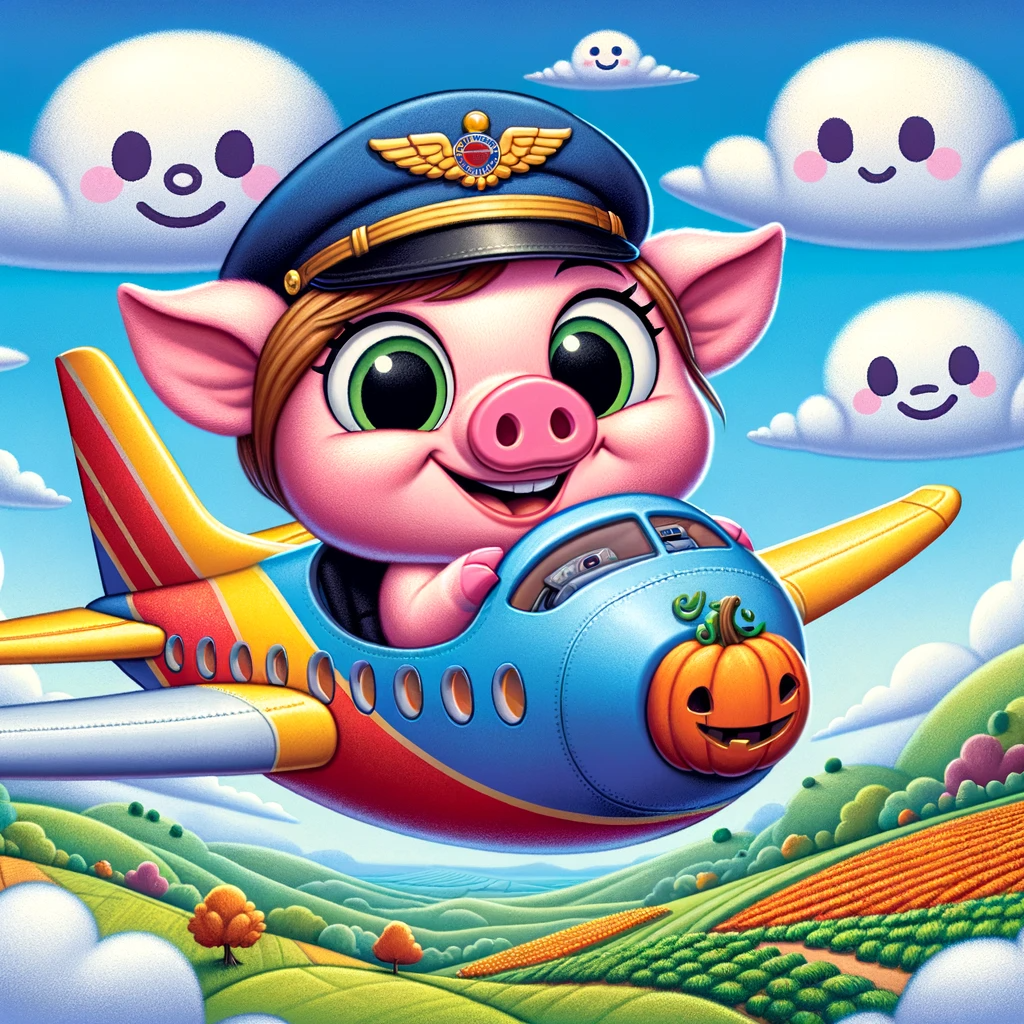
She squeezed through a gap in the collapsing boards and paddled with all her might, tiny hooves churning the murky water. The rising tide swept her away, past the submerged fence posts and the shivering sheep clinging to hay bales. Penelope bobbed and weaved, dodging debris and clinging to a floating log for dear life. Exhausted but undaunted, she spotted a patch of green peeking above the flood – Farmer Jedediah’s old oak tree. With a final burst of strength, she clambered onto its sturdy branches, panting and triumphant.
Days turned into nights, the rain finally relenting to reveal a ravaged landscape. Exhausted farm animals huddled on higher ground, their usual cheer dampened by the flood’s destruction. But Penelope, perched on her oak kingdom, felt a surge of piglet power. She remembered the hidden patch of Farmer Jedediah’s prize pumpkins, untouched by the flood. With a determined snort, she plunged back into the muddy waters, navigating the submerged maze like a seasoned sailor.
She reached the pumpkin patch, her snout leading the way, and unearthed a treasure trove of orange spheres. One by one, she pushed them towards the shivering animals, creating a bobbing flotilla of food and hope. The exhausted sheep munched gratefully, the cows mooed in awe, and even the grumpy gander quacked a hesitant thank you. Penelope, the little piglet who dared to defy the flood, had become a beacon of resilience, her muddy fur shining brighter than any medal.
As the floodwaters receded and Hogbottom Hollow rebuilt, Penelope’s adventure became a legend. She wasn’t just a piglet anymore, but Penelope the Brave, the little pig who swam against the tide and reminded everyone that even the smallest snout can make the biggest splash. And as she basked in the warm sun, nibbling on a rescued pumpkin, Penelope knew that true grit and a heart full of acorns could overcome any storm, proving that sometimes, the greatest stories are written not in mud, but in the muddy paws of a determined little pig.
Modern Day Parallels
Penelope’s story of resilience and kindness mirrors modern challenges, such as the 2022 holiday travel turmoil and Southwest Airlines’ $140 million fine. The airline’s ordeal paralleled Penelope’s journey, offering a lesson in facing adversity. Rather than succumb to the chaos, Southwest had an opportunity to emerge stronger, learning from the experience to enhance their services and rebuild trust.
As turbulence rocked flights and stranded passengers during the 2022 holiday chaos, whispers of karma swirled amongst weary travelers. The $140 million fine that slammed Southwest Airlines later felt like divine retribution, a harsh echo of the disrupted dreams and trampled cheer. Some saw it as a cleansing fire, forcing the airline to confront its failings and rise anew, phoenix-like, from the ashes of disappointment.
Yet, amidst the sting of financial penalty, another perspective bloomed. Perhaps this wasn’t cosmic payback, but a spiritual crucible – a test of resilience and adaptability. Like a weary pilgrim traversing a storm-wracked mountain, Southwest could choose to stumble and succumb, or they could dig deep, learn from the treacherous paths, and emerge stronger, more compassionate guides for future journeys. This crisis, then, became a call to refine their service, mend frayed trust, and ultimately, rediscover the joy of carrying dreams aloft.
This narrative of overcoming adversity is further explored through the concept of divine retribution. Historically, humanity has sought to understand suffering and evil by attributing it to divine punishment. This perspective, influenced by the Just-World Hypothesis and religious narratives, provides a sense of order and moral balance. However, it risks victim blaming and oversimplifying complex issues. Understanding suffering and evil requires acknowledging the psychological and theological aspects, balancing the need for explanation with the recognition of multifaceted causes.
Penelope’s tale and the Southwest Airlines saga remind us that challenges, while daunting, offer opportunities for growth and transformation. In facing adversities, whether as individuals or organizations, the choice remains: to falter or to learn and emerge with newfound strength.
So, while the fine may resonate with notions of karmic justice, let it also serve as a potent reminder – challenges, like turbulent clouds, can obscure the path but hold the potential for unexpected transformations. It’s in navigating these storms, learning from every bump and lurch, that true purpose often emerges, guiding us towards a brighter, more harmonious horizon. For Southwest Airlines, and for each of us on our own turbulent journeys, the choice remains: will we succumb to the hardship, or will we find meaning, learn, and soar anew?
Divine Retribution: Attributing Punishment to Understand Evil and Suffering
Throughout history, humanity has grappled with the unsettling presence of evil and the seemingly unmerited suffering it inflicts. To make sense of such phenomena, many cultures have turned to the notion of divine punishment, attributing misfortune to celestial forces enacting karmic retribution or unleashing wrath. Today we will explore the human tendency to seek divine explanations for suffering, analyzing its psychological and theological underpinnings and its influence on understanding the nature of evil.
One key driver of this tendency is the need for explanation and control in the face of chaos. When confronted with unexpected suffering, particularly on a collective scale, humans naturally seek answers. Attributing misfortune to divine judgment offers a sense of order and control, suggesting that suffering isn’t random but linked to transgressions. This aligns with the Just-World Hypothesis, which posits that good deeds are rewarded and bad deeds are punished (Lerner, 1980). In the face of tragedies like natural disasters or epidemics, the belief in divine punishment can offer comfort by affirming that there is a moral order to the universe, even if it remains inscrutable to us.
Furthermore, the concept of divine punishment resonates with deeply ingrained theological frameworks. Abrahamic religions, for instance, often depict God as a righteous judge who metes out punishments for transgressions against divine law. This perspective is evident in texts like the Book of Job, where the protagonist’s suffering is attributed to God’s testing of his faith. Similarly, Greek mythology associates natural disasters with the wrath of Olympian deities towards mortals who transgress divine mandates. These theological narratives, deeply woven into cultural fabric, provide readily available frameworks for interpreting suffering as divinely ordained, offering both explanation and a potential path to redemption through repentance and atonement.
However, attributing all suffering to divine punishment presents certain limitations. It can lead to victim blaming, suggesting that individuals or communities deserve their misfortunes due to past misdeeds. This can be particularly harmful in cases of natural disasters or systemic injustices, where attributing responsibility to the victims only adds to their burden. Additionally, it can hinder efforts to address the root causes of suffering, as individuals may focus on appeasing divine wrath rather than taking practical steps to alleviate hardship.
The human tendency to attribute punishment to divine sources reflects a deep-seated need for explanation and control in the face of suffering. While it offers comfort and resonates with established theological frameworks, it is crucial to approach this perspective with caution. Recognizing the potential for victim blaming and misattribution is essential, and efforts to understand and address suffering should not solely rely on the lens of divine punishment. Ultimately, navigating the complexities of evil and suffering necessitates a multifaceted approach that acknowledges both the psychological and theological dimensions of this enduring human challenge.
Sources:
- Lerner, M. J. (1980). The belief in a just world: A fundamental principle of human cognition. Psychological Bulletin, 103(2), 212-248.





 Does God Exist?