It began like a phantom note, humming on the edge of perception. A flickering newscast, grainy images of silent figures pointing skyward, swallowed by the urban throng. “The Pointers,” a newscaster chirped, dismissing them as a fleeting blip in the attention-hungry void. I shrugged it off, another echo in the cacophony of the mundane.
Then, the world erupted. Social media buzzed with theories, news channels dissected their gestures, every corner echoing with the mystery. They materialized like urban mirages, in bustling plazas and sun-drenched beaches, their silence a stark counterpoint to our ceaseless chatter. Were they prophets, performance artists, harbingers of the unknown? We dissected their actions, searching for meaning in their vacant stares and unmoving limbs.
Days morphed into weeks, peppered with their uncanny appearances. The mundane felt tainted, every passerby suspect. Laughter choked in my throat when a meme flashed – “Next stop, grocery aisle, pointing at bananas!” But under the humor, a tremor of unease lurked.
Then, I saw them.
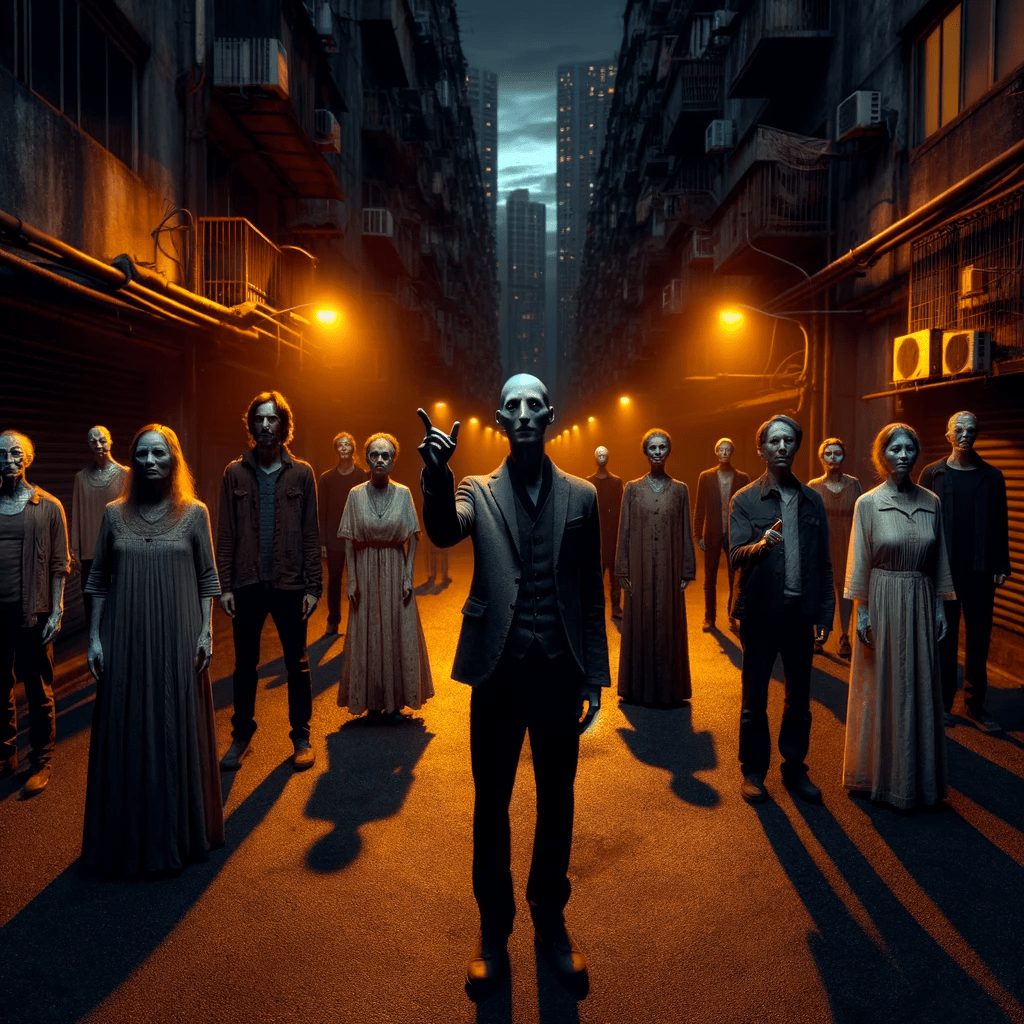
Dusk draped the alleyway in shadows as I hurried home, lost in the humdrum of daily chores. A sharp turn, a jolt of cold fear. They stood there, under the sodium glow, a spectral tableau. Faces etched with an alien serenity, arms outstretched towards the inky expanse above. No chants, no slogans, just the silent communion with the unseen.
A prickling crawled up my spine. For a heartbeat, I yearned to follow their gaze, to pierce the veil they seemed to glimpse. But there was only the familiar skyline, mocking my yearning. I bolted, haunted by their stillness, their unwavering certainty.
Sleep deserted me that night. Questions gnawed at the edges of my mind. Who were these people? What cosmic secrets did they glimpse? Why did their silence scream like a siren, dragging me towards an abyss I couldn’t fathom?
Morning brought no answers, only a renewed frenzy of speculation. The air crackled with anticipation, each new sighting a tiny earthquake in our complacency. Yet, as the days bled into weeks, the initial shock faded. Jokes returned, theories turned stale, and the Pointers became background noise, a quirky footnote in the daily newsfeed.
I, too, succumbed to the apathy. The urgency waned, replaced by a dull ache of unanswered questions. Life marched on, a relentless drumbeat drowning out the whispers of the sky.
Then, as abruptly as they arrived, they vanished. No fanfare, no final spectacle, just a poof of smoke, a blink, and they were gone. The media yawned, a half-hearted shrug, and turned its attention to the upcoming election, a drama far more palatable than the lingering enigma of silent sky-gazers.
The world moved on, but a splinter of unease remained lodged in my heart. The Pointers, with their unsettling quietude, became a ghost in the machine, a cryptic message etched in the tapestry of my memory. For they were more than just a fleeting phenomenon; they were a glimpse into the vast unknown, a reminder of the whispers that echo beyond the mundane, beckoning us towards… what?
The answer, I knew, wouldn’t come from news pundits or viral memes. It lay in the echo itself, in the lingering unease, in the shadows that danced at the edge of my vision. And somewhere, deep within the story I didn’t yet grasp, the Pointers were waiting, their silent song a prelude to the symphony to come.
The Shadow of Tragedy: Sophocles and Žižek on the Unbearable Weight of Loss
The news of today, January 15, 2024, paints a stark portrait of America grappling with the profound impact of tragedy. From the devastating school shooting in Iowa to the record-breaking arctic blast disrupting political campaigns, each story resonates with a sense of loss, uncertainty, and the enduring human struggle to find meaning in the face of suffering. Examining these events through the lens of two towering figures in the philosophical landscape – the ancient Greek playwright Sophocles and the contemporary Slovenian philosopher Slavoj Žižek – unveils a fascinating contrast in their approaches to tragedy, its origins, and the challenges it poses to our understanding of the human condition.
Sophocles: The Inevitability of Fate and the Catharsis of Suffering
Sophocles, the master of Greek tragedy, believed that human suffering was not merely random but woven into the very fabric of existence. In his plays, like Oedipus Rex and Antigone, he portrayed characters caught in the inescapable grip of fate, their downfalls driven by hubris, ignorance, and the cruel whims of the gods. Yet, amidst the darkness, Sophocles offered a glimmer of hope through the concept of catharsis. By witnessing the tragic downfall of his heroes, the audience, he believed, could experience a purging of their own negative emotions, ultimately emerging with a renewed sense of empathy and understanding of the human condition.
In the context of today’s news, Sophoclean tragedy finds resonance in the senseless violence of the school shooting. The sudden loss of Principal Jones and the trauma inflicted on the community serve as stark reminders of the fragility of life and the ever-present threat of unforeseen tragedy. Yet, amidst the grief and anger, there is also a potential for catharsis. Coming together to mourn, support one another, and demand action against gun violence can be a way for the community to process their collective suffering and emerge stronger.
Žižek: The Systemic Roots of Tragedy and the Peril of Misinterpretation
Slavoj Žižek, on the other hand, takes a more critical and systemic approach to tragedy. He argues that tragic events are not simply isolated incidents but often symptoms of deeper social and political fissures. In his analysis, the focus shifts from individual failings to the underlying power structures and ideological frameworks that contribute to suffering. For Žižek, the danger lies not in the tragedy itself but in our tendency to misinterpret it, seeking simplistic narratives and scapegoats to avoid confronting the uncomfortable truths about systemic inequalities and injustices.
Applying Žižek’s lens to the arctic cold snap, for instance, reveals the potential role of climate change denial and inaction in exacerbating the impact of natural disasters. The disruption of political campaigning serves as a reminder of the fragility of democratic processes in the face of environmental challenges. By focusing solely on the immediate disruptions caused by the weather, we risk overlooking the larger systemic issues that contribute to such extreme events.
The Enduring Relevance of Tragedy
Both Sophocles and Žižek, despite their vastly different approaches, offer valuable insights into the enduring relevance of tragedy in our lives. Sophocles reminds us of the universality of suffering, the fragility of human existence, and the potential for catharsis and shared humanity in the face of loss. Žižek urges us to look beyond the surface of tragic events and critically examine the systemic forces that contribute to them. He challenges us to resist simplistic narratives and confront the uncomfortable truths about the world we inhabit.
In the tapestry of today’s news, the threads of Sophoclean and Žižekian tragedy are woven together. The school shooting serves as a stark reminder of our individual vulnerability, while the arctic cold snap exposes the systemic consequences of our collective inaction. By engaging with these diverse perspectives, we can gain a deeper understanding of the impact of tragedy and its potential to shape our individual and collective responses in the face of adversity.
Ultimately, the question of how we respond to tragedy remains an open one. Whether we choose the cathartic path of shared grief and empathy, or the critical path of systemic analysis and action, the stories of today remind us that the shadow of tragedy continues to loom large, demanding our attention and challenging us to find meaning in the face of the unbearable weight of loss.



 Does God Exist?