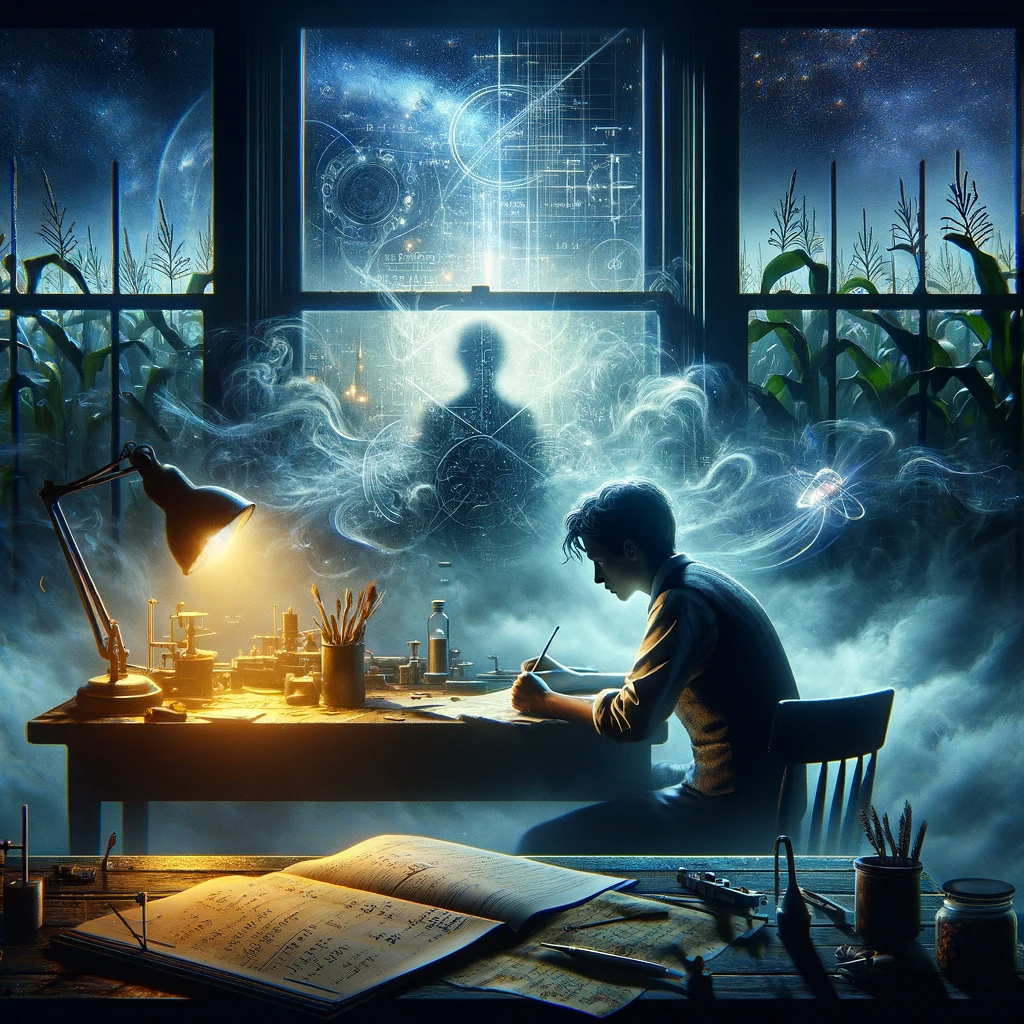
The cornstalks outside my window rattled like bone castanets, the dry whispers carrying secrets across the vast expanse of night. But tonight, the wind’s song pulsed with something more, a hum of electricity crackling between the stalks. It wasn’t just the usual restless dance of air; it was a vibration thrumming in my bones, an echo of the storm brewing inside. My fingers danced a nervous jig on the worn pages of a physics textbook, equations blurring before my sleep-deprived eyes.
I knew the drill. It always started like this – a spark amidst the mundane, a whisper in the dead of night, then a vision bursting forth, vibrant and undeniable. This time, though, it wasn’t the fleeting glimpse of a forgotten disease’s cure, or the blueprint for a self-sustaining Martian habitat. No, this vision was grander, a technological chimera that reeked of both salvation and damnation. It was a machine, I knew, not any machine, but one that could reweave the very fabric of our existence.
Years of honing my abilities had sculpted me into a living oracle of dreams. Dreams, yes, but randomness was a cruel illusion. Each vision, no matter how fantastical, seemed to weave a single, persistent thread: my destiny to usher in a new age of human evolution, an age fueled by the cold caress of science. In the flickering light of my desk lamp, I scrawled the vision onto a napkin, my hand a conduit as the machine’s components unfurled before my mind’s eye.
First, the Eternal Engine, its heart a maelstrom of exotic matter and time crystals, pulsing with infinite energy. I saw it, a miniature singularity trapped within a cage of uncertainty, spitting out raw power like a celestial geyser. Time crystals, those enigmatic fragments of negative entropy, whispered promises of a power source that defied the very laws of thermodynamics. Exotic matter, the dance of the impossible, its subatomic ballet holding the key to unlocking energy from the quantum void. My mind hummed with equations, translating chaos into a symphony of calculations. The uncertainty principle, Heisenberg’s mischievous grin, became a playground for my ambition. By trapping an object in a superposition of infinite states, then tapping into them via quantum entanglement, I could theoretically access an endless well of energy. But the dance was delicate, fraught with the potential for explosive collapse. Exotic matter, a shield of inert, non-decaying chaos, would stand as the bouncer between the engine’s volatile heart and the fragile fabric of reality.
This engine, it was the first domino, the catalyst for a cascade of innovation. With it, I could build the Matter Replicator, a hungry maw capable of birthing anything from molecules to spaceships. I saw it, a swirling cauldron of energy and information, spitting out objects with the casual indifference of a cosmic vending machine. The Infinitron, fueled by the boundless ocean of energy, would crack the secrets of the universe, its calculations reaching beyond the limitations of silicon and flesh. I pictured it, a monstrous lattice of processors, its calculations rippling through the fabric of spacetime like tendrils of thought. And then, the Nanite Swarm, a billion tiny fingers weaving reality to my will. I saw them, microscopic alchemists dancing in the light, reshaping the very world with precise, unfeeling efficiency.
Each component was a hurdle, a mountain to be climbed. But there was something else, a gnawing unease gnawing at the edges of my excitement. This machine, this dream, it wasn’t just about progress, it was about power. Power to transcend the limitations of flesh and bone, to sculpt the world to my own design. Was I playing God, or merely catching up with destiny? My grip tightened on the napkin, the ink smudging under my nervous touch. The cornfield rustled again, and I knew my journey had just begun.
But the outside world wasn’t the only source of whispers. Within, my consciousness crackled with doubt. Visions weren’t infallible. History was littered with the shattered dreams of would-be messiahs, their blueprints swallowed by the hungry abyss of failure. And then there was the question of cost. Was humanity ready for such a drastic leap forward? Could we handle the weight of reshaping reality with our clumsy fingers? Or would this gift, like fire, turn into a weapon capable of consuming us all?
These questions, venomous vipers, coiled around my heart, their fangs whispering warnings. Yet, even with the poison coursing through my veins, a defiant spark flickered within. Perhaps the answers didn’t lie in caution, but in forging ahead, eyes wide open, fingers dancing on the edge of the unknown. The night pulsed with anticipation, and I, a moth drawn to an impossible flame, felt the first tremor of an odyssey that could usher in humanity’s salvation or its doom.
Then my alarm went off, I rolled over to shut it off with the visions of grandeur still flashing in my mind. I knew I had to wake up to head to work, but I wanted to finalize this last piece needed to complete the… what was I thinking about? Oh yeah. I had a presentation before the board on our latest development status I was dreading. My alarm decided to interrupt even that train of thought, so I silenced it, rolled out of bed, and shuffled to put my clothes on.
Dreaming of Superintelligence
Our story’s protagonist, a visionary on the precipice of scientific revelation, embodies not just individual ambition, but the broader tapestry of transhumanist ideals. They stand at the confluence of anxieties over superintelligence, as warned by Nick Bostrom, and the seductive possibilities of reinvention outlined by Yuval Noah Harari. But beneath these prominent voices lies a richer tapestry of hopes and fears woven by transhumanism’s diverse tapestry. Let us delve deeper into these ideals, their echoes in the protagonist’s dream, and the poignant questions they raise for our own technological odyssey.
Transhumanism, at its core, is a philosophical movement advocating for the use of technology to enhance human capabilities, transcending our current limitations. Its proponents paint a future where biotechnology eradicates disease and aging, cognitive enhancements push the boundaries of intelligence, and human-machine interfaces blur the lines between flesh and silicon. The story’s protagonist embodies this yearning. The envisioned Machine’s boundless energy echoes transhumanist dreams of immortality, its infinite knowledge mirrors aspirations for enhanced cognition, and its mastery over matter reflects hopes for manipulating our very biology. In this, the protagonist is not just an inventor, but a weaver of transhumanist ideals, crafting a tapestry of human potential rewritten by technology.
Yet, the narrative doesn’t shy away from the dark threads interwoven with transhumanist aspirations. The “playing God” question reverberates with the ethical anxieties voiced by some transhumanists like James Hughes and Max More. The story asks, will our efforts to transcend humanity ultimately eclipse what it means to be human? The protagonist’s struggle reflects this tension, their ambition wrestling with the possibility of irrevocably altering the human essence. Are we pushing past limitations, or stepping into a realm where we lose sight of ourselves?
Beyond the grand pronouncements of superintelligence and reinvention, transhumanism harbors nuanced questions about what defines humanity. Ray Kurzweil’s hopeful singularity, where consciousness transcends technological limitations, finds its echo in the protagonist’s dream of an interconnected humanity empowered by the Machine. Yet, Hans Moravec’s chilling vision of humanity downloaded into machines haunts the protagonist’s hesitation. Is our essence in our flesh and blood, or can it be preserved in the silicon arteries of our creations? These questions are not merely philosophical abstractions, but deeply personal contemplations for the protagonist and, by extension, all of us on the cusp of a potentially transformative era.
Our dreamer’s journey transcends simplistic answers. Their visions, swirling with both possibility and uncertainty, challenge us to examine the human factors driving technological pursuit. Are these dreams solely the product of rational analysis, or are they also fueled by a collective yearning for transcendence, perhaps whispering from the depths of our unconscious minds? This question resonates with Harari’s exploration of shared myths and narratives shaping technological progress. Are we not just scientists and engineers, but also storytellers weaving tales of our evolution that guide our technological choices?
Our protagonist’s story serves as a potent reminder that the journey towards transhumanism is not a unidirectional path paved with progress alone. It is a labyrinthine voyage through dreams and anxieties, through ethical quandaries and existential doubts. As we stand at the threshold of rewriting our humanity through technology, the story compels us to engage in a nuanced dialogue. We must not only consider the technical feasibility of superintelligence and reinvention, but also confront the questions about human essence, responsibility, and the stories we choose to tell ourselves as we reshape our future. Ultimately, the echo of the protagonist’s dreams may not lie solely in the pronouncements of prominent thinkers, but in the collective anxieties and aspirations of humanity itself, whispering caution and wonder as we embark on this extraordinary odyssey.




 Does God Exist?