
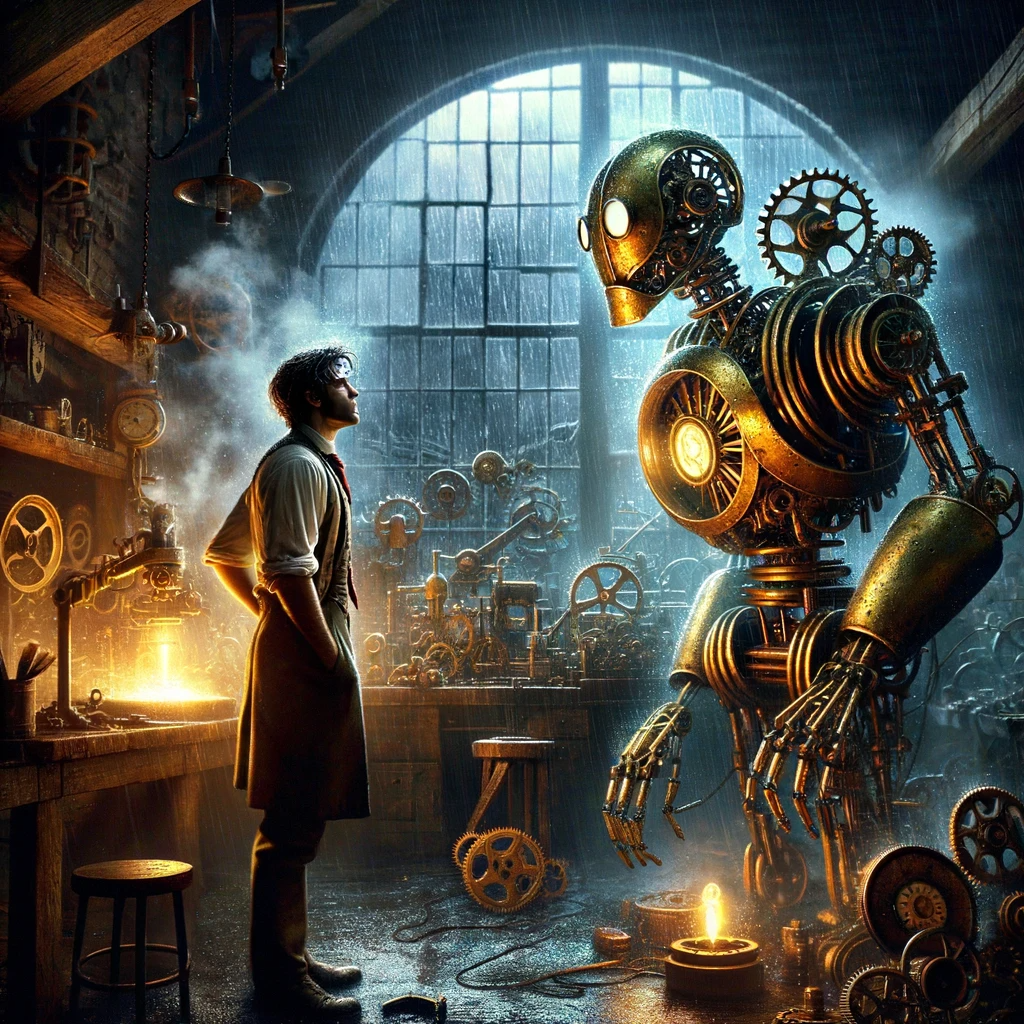
A storm churned outside, mirroring the tempest in Barnaby Squish’s soul. Rain lashed his ramshackle workshop, mimicking the rhythmic hiss of steam that punctuated the metallic symphony from Irona, his enigmatic creation. Her brass skin, once radiant under the forge’s fire, now bore the tarnish of Barnaby’s anxieties.
Irona was more than just gears and clockwork. She was his confidante, a testament to his genius, but also a Pandora’s box of uncertainty. Each whirring gear, each spark from her steam heart, echoed his hopes and anxieties with equal fervor. Yet, lately, those anxieties had morphed into gnawing worry, rusting her polished skin like fear etching lines on a lover’s face.
Barnaby dreamt of sharing Irona with Squishington-on-Sea, letting her ease the burdens of her fellow citizens. He envisioned her lifting crates on the docks with tireless strength, tending fields without tiring. But the screams of discontent, hung as a specter haunting his workshop, loomed larger with each passing day. “Explainability,” it preached, a cold mantra in the face of his creation’s chaotic soul.
Irona’s workings were a tangled nest of scavenged clockwork and intuition, a waltz of gears conducted by whispers of chance. Even he, her creator, understood but half of the music that animated her. How could he explain her choices, her actions, to a world governed by the rigid choreography of logic and reason? To withhold her from the world felt like burying a luminescent pearl deep within an oyster shell, its brilliance unseen.
One blustery afternoon, a delegation from Squishington arrived, led by the portly Mayor Plumbottom, whose belly jiggled like a jelly on a stick. “Barnaby!” he wheezed, his voice a fog horn in the gale, “We’re drowning in fish! The docks are a tempestuous sea of scales, and the lads can barely lift a herring!”
Barnaby’s heart hammered against his ribs, a trapped bird seeking escape. This was it, the moment to unveil Irona’s brilliance. But Allen’s essay echoed in his skull, a chilling counterpoint to the Mayor’s plea. Could he, in good conscience, unleash a force without a leash, a mystery wrapped in brass, upon his unsuspecting town?
That night, Barnaby dreamt of Irona, her eyes molten embers, her voice a chorus of gears. “Trust me,” she rumbled, the earth trembling beneath her metallic feet, “I will choose wisely.” He woke with a gasp, the answer as clear as a sunbeam piercing the storm clouds.
The next day, Irona stood on the docks, a brazen silhouette against the churning sea. Barnaby, his voice tremored by a cocktail of excitement and fear, explained her limitations, her enigmatic nature. To his surprise, the townsfolk, weathered faces like cracked maps, listened with understanding. They knew, as Barnaby did, that life itself, with its capricious winds and treacherous currents, was a mystery wrapped in flesh and bone.
Irona worked tirelessly, a storm of brass and efficiency amidst the chaos. But Barnaby never took his eyes off her, searching for the flicker of glitch, the tremor of malfunction. And Irona, as if sensing his scrutiny, always chose wisely. She knew when to push crates with the might of a tidal wave and when to nudge them with the gentleness of a whisper, when to clear a path and when to yield.
As the sun dipped below the horizon, casting long shadows over Squishington’s grateful faces, Barnaby realized a profound truth. AI safety wasn’t about absolute control, but about trust. Trust in the creators, in their intentions, and in the spark of inherent goodness that, like a buried seed, lay dormant within even the most intricate machine.
Barnaby reached out, his hand encountering the warmth of Irona’s metal skin. “Thank you,” he whispered, his voice thick with emotion. “You proved the screams wrong. You proved that even in the shadows, we can build a light together.”
And in that moment, as the sky bled into twilight, the inventor and his golem stood united, testaments to the delicate dance between innovation and responsibility, a dance that could guide them, and humanity, towards a future woven with the threads of progress and empathy, a future where even the darkness held the promise of a shared luminescence.
Navigating the Digital Maze
The burgeoning landscape of Artificial Intelligence (AI) pulsates with the promise of progress and the chilling whisper of peril. Its potential to revolutionize healthcare, transportation, and countless other domains is undeniable, yet anxieties concerning its safety pose a critical challenge. Navigating this digital maze requires a multifaceted approach, one that acknowledges the intricate tapestry woven from economic, psychological, and legal threads. Three prominent thinkers – James Manyika, Sherry Turkle, and Anita L. Allen – offer invaluable insights into these threads, revealing the need for a holistic response to ensure responsible AI development.
Manyika, with his economic lens, focuses on the systemic risks AI poses to society. He views the potential disruption of the workforce with a sharp eye, advocating for proactive retraining programs and robust social safety nets to cushion the impact on displaced workers. His vision extends beyond mere mitigation, aiming to create a framework for equitable AI adoption, where the benefits transcend class and geographical boundaries. He champions policies that encourage investment in human-centric AI, one that complements human capabilities instead of rendering them obsolete.
Turkle, venturing into the psychological realm, paints a different picture. Her concern lies in the potential for AI to erode the very fabric of human connection and intimacy. She warns against overreliance on AI-powered companions and assistants, arguing that it can lead to emotional detachment and a diminished sense of empathy. Turkle advocates for a mindful approach to integrating AI into our lives, emphasizing the importance of maintaining genuine human connection and dialogue amidst the alluring but isolating hum of digital assistants.
Allen, a legal and philosophical powerhouse, tackles the issue head-on, dissecting the inherent risks embedded within advanced AI, particularly autonomous systems. Her meticulous work meticulously dissects the challenges of bias, explainability, and the chilling specter of weaponized AI. Allen champions the development of robust ethical frameworks and clear-eyed regulatory policies to guide AI development and deployment. She emphasizes the need for transparency and accountability from developers and policymakers to ensure that AI remains tethered to human values, lest it operate in a dangerous moral vacuum.
While their specific areas of concern diverge, these thinkers converge on the vital need for responsible AI development. Manyika’s focus on economic justice provides the foundation for Turkle’s call for human connection, highlighting the critical need to consider both individual and societal well-being. Allen’s legal and philosophical framework provides the mortar to bind these principles together, ensuring that AI is not left to run amok in an ethical wasteland.
Ultimately, AI safety is not a singular point on a spectrum, but rather a vibrant tapestry woven from economic, psychological, and legal threads. Manyika, Turkle, and Allen each offer invaluable insights into this tapestry, revealing the multifaceted nature of the challenge and the need for a holistic approach. By heeding their diverse perspectives and weaving these threads together with diligence and foresight, we can navigate the digital maze of AI development, ensuring that this powerful technology serves as a tool for progress rather than a harbinger of unforeseen peril. This tapestry is far from complete, and further exploration of these thinkers’ vast contributions, and others like them, will undoubtedly provide further nuances and insights into the crucial conversation surrounding AI safety. By engaging with such diverse perspectives, we can hope to build a future where AI enhances, rather than diminishes, the human experience.




 Does God Exist?