
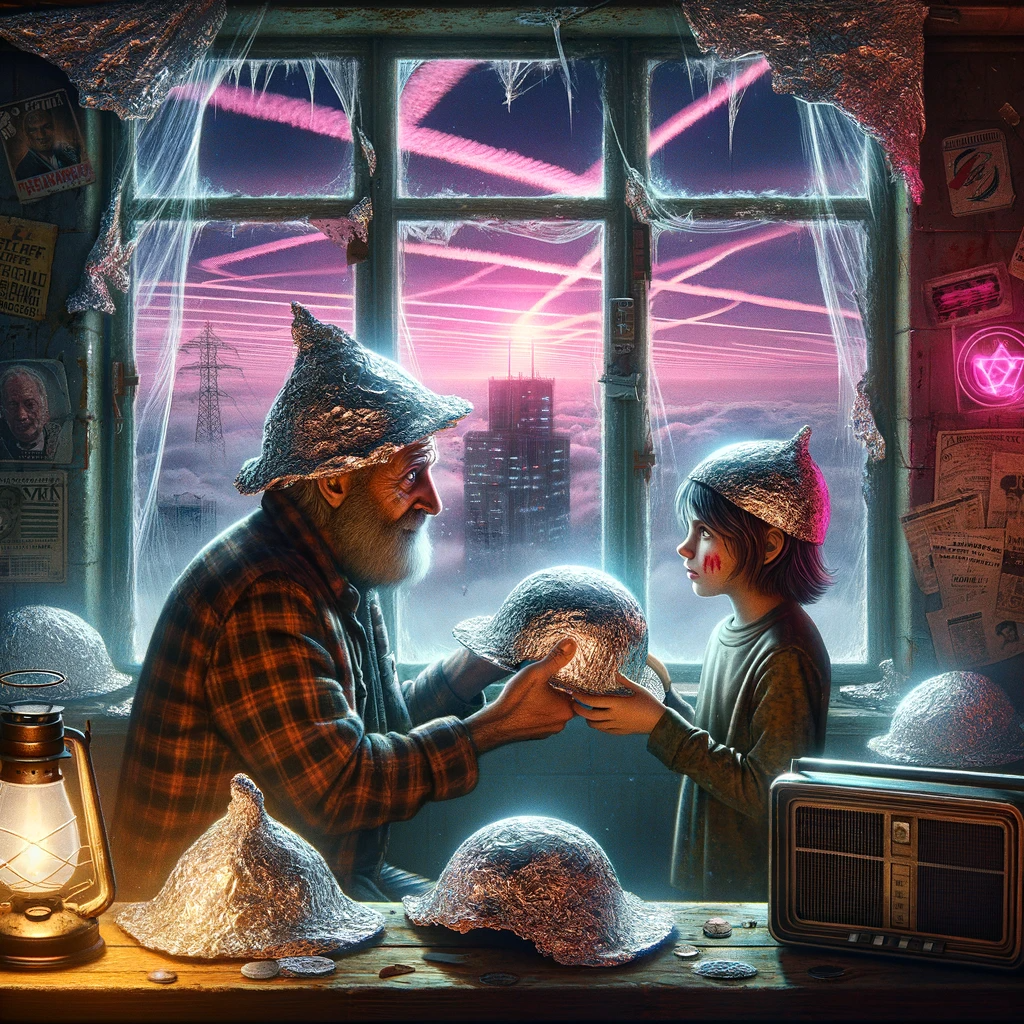
Tim squinted at the world through a panel of chipped plexiglass. Outside, the once vibrant sky bled neon pink, perpetually smeared by the chemtrails of the Reptilian Illuminati. He stroked the aluminum foil lining his bunker, its crinkled surface reflecting the warped reality beyond. He was Tim, the last Tinfoil Titan, the lone sentinel against the insidious tide of the Red Hatted Horde.
It began subtly. A rash of crimson caps sprouting amidst the cornfields, like poppies after a Martian invasion. Tim, ever the skeptic, had noticed the vacant eyes, the twitchy movements, the insatiable cravings for Big Macs and reality TV. He’d dissected one, under the flickering gaslight of his generator, and recoiled in horror. Beneath the felt, nestled in a pulsating mass of grey, was a creature he’d only seen in grainy YouTube videos – a Brain Slug, a mind-controlling parasite from the Zeta Reticuli system.
His initial warnings were met with scorn, branded a hysterical rant by the red-hatted masses. Soon, his once bustling tinfoil emporium became a pariah, a beacon of dissent in a landscape draped in crimson conformity. People stopped looking up, stopped questioning. The Great Hypnosis, as he called it, had begun.
Years went by. The sun, dimmed by chemtrails, cast a permanent twilight. His once-booming business dwindled to the occasional stray squirrel seeking protection from the mind-melting rays. His shelves overflowed with tinfoil hats, each one a silent testament to his lost crusade.
Loneliness gnawed at him, sharper than the chem-infused rain battering his corrugated roof. His radio sputtered with government-approved propaganda, the dulcet tones of the Lizard Queen droning about economic prosperity and the benefits of mandatory brain scans. Even the cockroaches seemed strangely placid, their antennae drooping with docility.
One day, he heard a scuffle, a whimper. A figure stumbled into his bunker, a young girl, her face streaked with grime and defiance. She didn’t wear a red hat, instead clutching a crumpled tin foil ball like a talisman. “They followed me,” she gasped, “said I ask too many questions.”
Tim, for the first time in years, felt a spark of hope. He wasn’t alone. Maybe, just maybe, the embers of resistance still flickered beneath the programmed calm. He handed her a gleaming tinfoil helmet, its surface catching the dim light like a thousand captured sunbeams. “Welcome, child,” he rasped, “to the last bastion of sanity.”
As the girl donned the hat, her eyes regained their lost spark. Tim, the Tinfoil Titan, wasn’t so alone anymore. In the twilight of a hypnotized world, he had found his apprentice, his heir to the mantle of vigilance. The fight against the Brain Slugs might be uphill, but with every new tinfoil-clad head, the glint of rebellion would grow brighter, a beacon in the chemtrail-choked sky. Tim smiled, a smile etched with hardship and hope. The Great Hypnosis might have lulled the world, but in his humble bunker, the revolution of aluminum foil had just begun.
The Tin Foil Prophet: A Parable of Echo Chambers and Societal Blindness
Tim, the lone tinfoil hat salesman battling against the Red Hatted Horde, is more than just a quirky character in a sci-fi short story. He serves as a stark parable for the dangers of social conformity and echo chambers in our present society. The insidious rise of the red hats, initially met with resistance, ultimately drowns out dissent through sheer overwhelming presence, a chilling reflection of how groupthink and unchallenged narratives can erode critical thinking and stifle progress.
The crux of the story lies in the brain slugs, creatures of conformity that thrive in environments devoid of opposition. They represent the seductive ease of adopting dominant narratives, however flawed or manipulative. As more people succumb to the brain slugs, the lines between sanity and conformity blur. Tim, the isolated voice of reason, becomes marginalized, even pathologized, in a world blinded by its own reflection.
This mirrors the real-world echo chambers created by algorithms and social media, where individuals are increasingly exposed to information that reinforces their existing beliefs, while dissenting voices are relegated to the periphery. This curated reality fosters a false sense of consensus, making it increasingly difficult to challenge dominant narratives, however harmful they might be.
The consequences of societal blindness are multifaceted. Without diverse perspectives and critical thinking, societies become susceptible to manipulation and misinformation. Innovation stagnates, replaced by the comfortable echo of the familiar. The story’s bleak depiction of a chemtrail-choked sky and docile cockroaches under the hypnotic rule of the Lizard Queen paints a vivid picture of a society robbed of its potential, its collective imagination suffocated by the tyranny of the red hats.
However, Tim’s story is not solely one of dystopia. The arrival of the young girl, her face alight with defiance, offers a glimmer of hope. It signifies the inherent human capacity for independent thought and the persistence of dissent even in the face of overwhelming conformity. Just as a single tinfoil hat can reflect sunlight back to the source, a solitary voice, when amplified, can pierce through the fog of misinformation and rekindle the flames of critical thinking.
The parable leaves us with a haunting question: will we succumb to the allure of the Red Hatted Horde, choosing comfort over curiosity, or will we embrace the spirit of Tim, the lone tinfoil prophet, and challenge the narratives that threaten to blind us to the truth? The answer lies in our collective ability to break free from the echo chambers we create, to actively seek diverse perspectives, and to defend the right to question, even when it means standing alone. Only then can we ensure that the sun, despite the chemtrails, continues to shine on a society illuminated by the light of critical thinking and intellectual diversity.




 Does God Exist?