
Echoes of an Unfortunate Childhood
The faint smell of stale coffee lingered in the small, unassuming therapy room. Susan Wright, with her creased brow and warm smile, shifted the papers on her lap. A new patient file lay open – Josephina, age 32. The referral notes mentioned severe anxiety, social withdrawal, and an… unusual fixation.
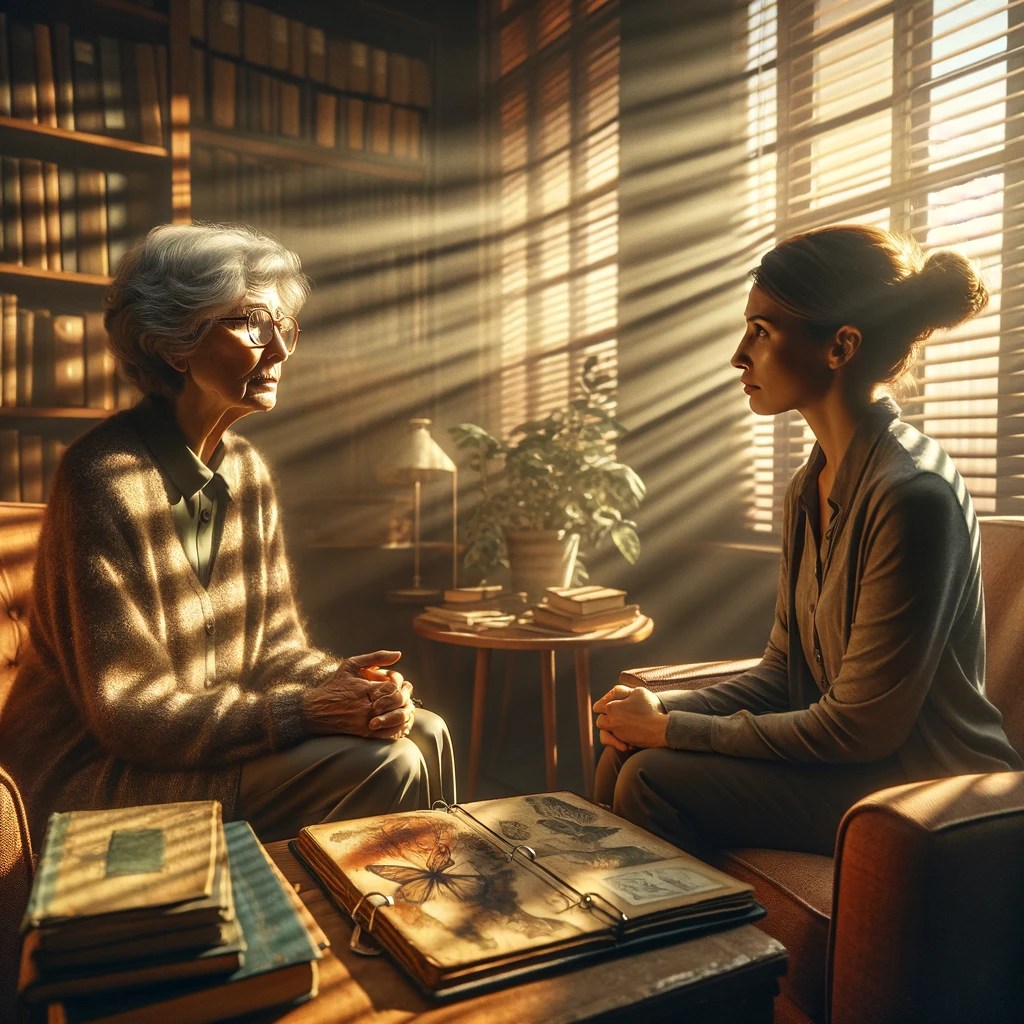
“Thank you for coming in, Josephina,” Susan began in a gentle voice. “Could you tell me a little about what brings you here today?”
Josephina, a frail-looking woman with oversized glasses that dominated her face, hesitated. She tugged at a loose thread on her cardigan. “It’s hard to explain. The adults in my life…they’re never what I expect.” Her voice wavered.
Susan leaned forward, “Could you elaborate?”
Josephina’s fingers tightened around the frayed thread. “When I was young…well, you see, I had some rather extraordinary things happen to me.” She paused, seemingly gauging Susan’s reaction.
“That sounds intriguing,” Susan encouraged, her expression neutral.
Josephina swallowed, a flicker of something unresolved in her eyes. “You’ve likely heard the stories… about the orphans with the cruel count who wanted their fortune. Or the boy who escaped his horrible aunts by living in a giant peach?”
Susan blinked, processing the familiar titles. “Lemony Snicket… James and the Giant Peach… Are you saying…”
“Yes.” Josephina’s voice rose slightly, “Those weren’t just stories! Those were about me. My life.”
A long silence ensued. Susan delicately cleared her throat. “I see… Could you describe one of these… extraordinary events?”
Josephina launched into a bizarre recollection of a school event nearly ruined by overbearing teachers and a catastrophic cake with hidden ingredients (a teacher who ended up with Munchausen syndrome). As she spoke, her tone was oddly matter-of-fact, as if detailing a trip to the grocery store, not some horrific, outlandish experience.
“These things happened all the time,” Josephina concluded, “I didn’t understand why nobody listened, why adults were always sabotaging even the simplest desires. Just walking to the store to buy some milk, all the adults were complete… they were evil” She met Susan’s gaze, a strange intensity in her eyes. “I thought growing up would change things. It hasn’t. Everyone is still terribly horrible.”
Susan tapped her pencil against the notepad. “Do you mean that in a literal sense – that people directly try to hinder you?”
“Perhaps… or maybe they just don’t care.” A touch of bitterness surfaced in Josephina’s voice. “Like the time my boss ‘accidentally’ deleted weeks of my work, and then laughed at me when he made me give a presentation with a deleted powerpoint he “rescued”, or when I bought a winning lottery ticket only to have a homeless person out front mug me because I only gave them $20. There’s always an obstacle, always someone standing in the way.”
As Josephina spoke, Susan began to suspect the root of her troubles lay somewhere deeper than mere daily disappointments. Something about the unwavering belief in an almost conspiratorial level of adult malevolence was unsettling.
“Let’s unpack this a bit more,” Susan suggested. “These recurring incidents sound distressing. We can work on strategies to help you navigate those.” She paused, “Would you mind if we revisit these ‘childhood adventures’ in our next session, perhaps explore them further?”
Josephina nodded slowly, a hint of relief softening her features. Leaving the room, she turned back for a moment, her voice barely a whisper, “Do you think I was also the kid with the diary? You know, the wimpy one?”
Whispers of Stolen Tales
Sessions unfurled like delicate origami before Susan realized they’d built the beginnings of a fragile trust. With each appointment, Josephina seemed more willing to peel back layers, not just of the grand childhood ordeals, but the quieter struggles – the sting of overlooked promotions, the loneliness of holidays echoing back memories of strained family gatherings. Each account was delivered with a lingering trace of resentment, as if every disappointment served as further proof of the world’s inherent unfairness.
This sense of cosmic injustice seemed woven into the very fabric of Josephina’s being, and Susan’s curiosity grew deeper. What seeds had germinated into this unshakable belief? Why had fictional stories so deeply infiltrated Josephina’s sense of self? More importantly, why was Josephina letting this past trauma cause her to see everyone around her as “enemies?”
One afternoon, after another meticulously recounted instance of workplace sabotage, Josephina paused. An almost sheepish expression crossed her face. ”Is it…strange,” she began tentatively, “if I show you something? This sounds crazy, but I think it might have something to do with all this…”
Josephina placed a weathered scrapbook on the desk, its cardboard cover faded and worn. Her touch upon it was gentle, protective. It seemed to hold years of bottled-up pain and perhaps a strange sense of distorted pride. Sunlight filtered through the office blinds, casting elongated shadows on Josephina’s worn scrapbook. Across the desk, Susan studied her patient with growing curiosity.
“You said… you knew the protagonists in these stories personally?” Susan prompted gently.
Josephina nodded, her fingers tracing faded paper clippings and handwritten letters. “Oh yes, it all makes sense now, doesn’t it? See this?” She lifted a frayed postcard adorned with crude stick figures, “This was supposed to be a family portrait for Mr. Handler. I drew it. But he used someone else’s!”
“These were childhood letters?” Susan examined them carefully, noticing a consistent blend of admiration and thinly veiled frustration in the childish tone.
“I told them everything,” a note of sorrow touched Josephina’s voice, “My terrible science fair project, how my neighbor snooped in my mail…the dreadful things everyone said behind my back.” She paused, looking up at Susan with an almost accusatory expression. “They stole my life, turned it into entertainment!”
Tapping her pencil on her teeth, Susan pondered “So how did you meet these authors?”
Josephina seemed to ponder this, then shrugged her shoulders. “Growing up I was just so lonely, so I would write to strangers, pen-pals through newspaper and magazine adverts. I never really knew who they were, at first – but even after I knew, I couldn’t figure it out because most of them used fake names.”
Josephina pulled out another letter. “This is the one I wrote Mr. Handler, I mean Mr. Snicket about how thrilled I was reading the first Lemony Snicket book, where it detailed my time with my awful uncle after my parents died. I had no idea he was the one who wrote it.”
Susan shifted uncomfortably. An eerie pattern began to emerge, this bizarre fixation on stories bleeding into Josephina’s perception of reality. She chose her words carefully. “Josephina, writers often find inspiration in everyday life. Perhaps these childhood anecdotes struck a chord, and became part of their fictional work.”
A look of indignation flashed across Josephina’s face. “It’s not just inspiration, it’s theft! This passage –” she thrust the scrapbook onto the desk – “… it describes, word for word, when my cousin accidentally shaved off my eyebrows! How could anyone else know that?”
Susan studied the faded ink. It did sound vaguely familiar. Had she once read a book with a similar scene? “These might be coincidences…” she started.
“Absolutely not! I was their muse,” Josephina declared, a wave of defiance rising in her. “It wasn’t fair. They got rich and famous on the back of my misfortunes. Why couldn’t I?” A mix of sadness and righteous anger simmered beneath her thin voice.
Susan leaned back, a new thought crystallizing in her mind. “Did this feeling – that everything’s stacked against you – did it start around the same time you were reading all these novels?”
“Not really. At first it gave me a lot of comfort, reading the stories as I was growing up. Feeling like someone else was out there going through the exact same things I was.” Josephina said with a wistful smile.
Resment filled her eyes as she continued, “I started expecting bad things after a while. Maybe… maybe I got fixated on how unfair it all was, and it got worse?”
She looked at Susan, a tinge of hope in her eyes. “Can you… fix this?”
A complex web formed in Susan’s mind. Was this some elaborate delusion, or something far more deep-seated? She needed clarity. “Would you be willing to tell me more about the circumstances around your childhood? Not just the incidents you shared with the authors, but other aspects of your life, too?”
Josephina hesitated, then a wave of resignation washed over her. “Before my parents died, they never had much time for me, always with their own problems. My classmates…” she trailed off. “Kids can be cruel, can’t they?”
Susan nodded encouragingly. A chilling realization struck her: wasn’t this precisely the environment depicted in all those books? And if a vulnerable child found only pain and disappointment reflected in fictional characters, wouldn’t the lines between imagination and reality begin to blur?
Josephina fidgeted in her chair, hands folded neatly over the edge of the scrapbook – her constant, tattered shield.
“Josephina,” Susan began, “we’ve spent a lot of time untangling these… perceptions of yours. I understand your anger, your sense of injustice.” She watched as Josephina’s gaze hardened. “But I want to talk about a different kind of action. One that could help not just you, but others like you.”
Josephina stared at her with that familiar blend of perplexity and distrust. “You mean… more talking?”
“Actually, quite the opposite.” Susan took a deep breath. “Have you thought about taking legal action against the authors?”
Silence clung to the room like a stifling cloak. Josephina’s eyes bulged behind her thick lenses. “Sue them? Seriously?” Her voice shook with a mixture of disbelief and a tinge of excitement.
“Hear me out,” Susan said, her tone purposeful. “I know your motivation wasn’t financial, but the truth is, this case could create a legal precedent. Think about it – it could expose how vulnerable young minds can be unduly influenced by fictional narratives, leading to real-world suffering. Especially adults who take advantage of anonymous pen pals.”
Josephina’s expression shifted as she contemplated this. “So, what, I go against these famous millionaires with my story of misery? Despite what they did, I grew up with their stories, and they really meant a lot to me. It doesn’t sound like a fair fight.”
“We won’t focus on winning or losing. The very process, the fact that we put these issues on a public stage, it would expose the cracks in how we address childhood emotional neglect,” Susan said. “Maybe then, children reading the books you loved wouldn’t feel so alone, so reflected in tales of constant disappointment.”
“Make them… take responsibility?” A tiny glint ignited in Josephina’s eyes.
“Perhaps not in the way you imagine. True responsibility,” Susan explained, “comes not from making villains out of these writers, but revealing that childhood pain isn’t something to be packaged as entertainment. It’s something to be understood, taken seriously.”
A curious resolve dawned on Josephina’s face. It wasn’t the vengeful glee of a victim anticipating retribution, but the steely determination of a survivor demanding accountability, albeit in the most bizarrely roundabout way. She picked up her scrapbook and squared her shoulders.
“You know what? Let’s do it. Let’s show them,” she said, a touch of defiant triumph lacing her quiet voice. “Maybe this ‘unfortunate childhood’ can give some other kid a better chance.”
A Pyrrhic Victory
The courtroom proceedings that began as a spectacle slowly transformed. Skeptical snickers from the initial press reports dwindled as Josephina’s story became about more than just bizarre claims of literary theft. Beneath the fantastical elements of the case, Susan’s measured testimony about the psychological repercussions illuminated the dark corners of Josephina’s psyche. Her relentless pursuit of restitution – of rewriting her tragic childhood – started to be viewed as a desperate need for validation, for acknowledgment that her suffering went beyond petty mishaps. It wasn’t about proving literary plagiarism anymore, but exposing the neglect and loneliness that left her clinging to tales of equally unfortunate children.
Yet, in the sterile space of the courtroom, something felt unresolved. There was an unease that gnawed at Susan. Even if Josephina won – was justice measured in a monetary judgment? And even if the authors received some kind of public condemnation, did it undo a childhood warped by a toxic belief in misfortune?
Perhaps there was a chance for victory to exist outside this battleground. It wasn’t about erasing the scars of the past but using this public attention to focus on future interventions. And that’s where Susan felt compelled to intervene, to suggest an unusual proposition to her client…
The air in the courtroom crackled with a bizarre tension. Josephina, once a withdrawn figure, sat confidently with her attorney. Across the aisle, three celebrated authors – now gray-haired and bewildered – fidgeted under the harsh courtroom lights. Susan leaned back, witness to a saga playing out far beyond her usual therapy sessions.
The lawsuit had been a media sensation. “Woman Claims Beloved Authors Plagiarized Her Unfortunate Childhood,” screamed the headlines. Initially dismissed as a frivolous publicity stunt, the case somehow gained traction. Josephina presented meticulously compiled evidence: letters, drawings, even forgotten birthday cards mentioning details that later mirrored fantastical plot points in the novels.
Susan testified about the psychological impact on her patient, describing a feedback loop of paranoia and disappointment fueled by a distorted world constructed from children’s literature. The judge, perhaps intrigued by the sheer peculiarity of it all, ruled in Josephina’s favor.
News of the verdict traveled fast. Susan received mixed reactions from colleagues: some were skeptical, others strangely fascinated by this unique case at the intersection of mental health and intellectual property law. In the public eye, Josephina became alternately villainized as a gold-digger and hailed as an eccentric underdog fighting the system.
Her sudden wealth became a bittersweet reality. While Josephina finally achieved the “victory” she’d sought, life didn’t magically transform. Rude customers, canceled flights, and miscommunication lingered on as ever-present reminders of life’s imperfections, because even with money adults are terrible. Her deep-seated distrust of others couldn’t be expunged along with her bank balance.
During one therapy session, Susan saw a new glimmer in Josephina’s eyes. It wasn’t pure contentment, but a flicker of wry resignation.
“It’s been… disillusioning,” Josephina admitted, a touch of her old timidness returning. “Being rich can’t make people kinder, or fix all my anxieties.” She smiled faintly, “Though it does afford a rather good therapist.”
Susan offered a warm smile in return. Perhaps the true accomplishment wasn’t the financial windfall, but a confrontation with the root of Josephina’s turmoil. With that broken foundation exposed, healing – slow and frustrating as it might be – could truly begin.
Weeks later, a small news item piqued Susan’s interest. A sizable anonymous donation had been made to a charity focusing on childhood trauma prevention. And while the article ended there, Susan had a hunch.
The journey hadn’t turned Josephina into a carefree optimist – there was too much damage for that. But somewhere along the way, a shift had occurred. She faced the truth: life held both blessings and disappointments, and that no lawsuit, however bizarre, could change that universal condition. It was an oddly profound victory, born out of a most unusual case.




 Does God Exist?
One response to “The Girl Who Sued Her Unfortunate Life”
Oh, incredible read.❤❤
Love your content🙏
LikeLike