
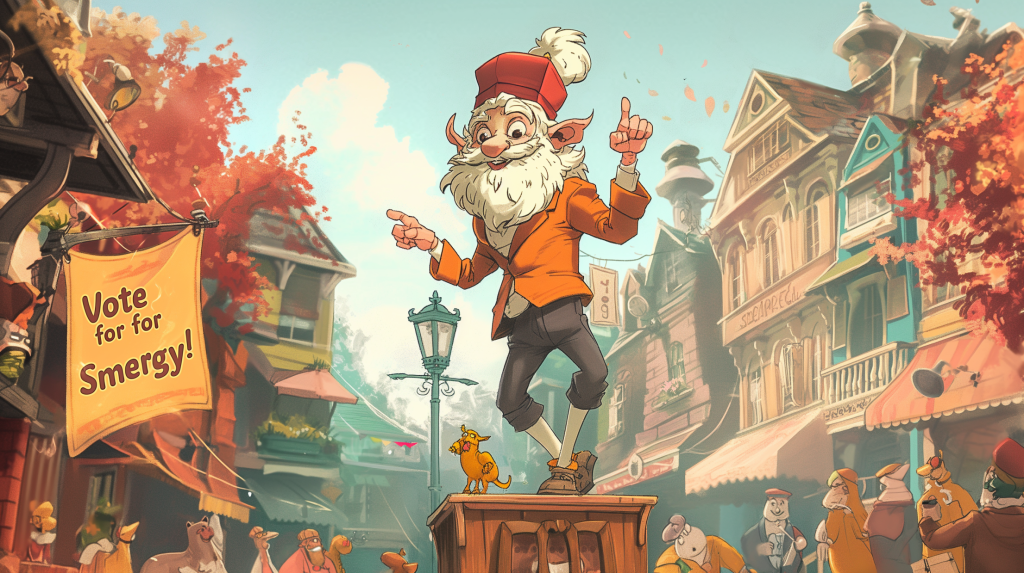
Chapter 1: Campaign Chaos
In a sleepy hamlet of Manhattan, where the pace of life meandered with the charm of a wayward turtle, Smergy Rumptweister held a position of understated significance–or so he liked to believe. City janitor. Custodian of cleanliness. Master of the mop. While others might wrinkle their noses at such a title, Smergy relished the responsibility inherent in his work, convinced that with each swipe of his trusty mop, he safeguarded the very foundations of civilized society.
Unfortunately, in his zeal to combat the encroaching forces of entropy, Smergy often left behind a fresh swathe of chaos. Books inexplicably shuffled to the wrong shelves at the library, a curious rearrangement of office supplies after hours at city hall, and an ever-present sheen of smudged fingerprints that seemed to mysteriously reappear despite his best efforts. Smergy was a walking, talking testament to the phrase “good intentions, poor execution.”
But beneath the spray-tanned exterior and valiantly misapplied comb-over beat the heart of a dreamer. Smergy longed to leave his mark on Manhattan, to elevate himself beyond the humble dominion of dust and grime. Then, inspiration struck as brightly as the searing fluorescent bulbs of the local supermarket: he would run for mayor!
The announcement was made over a squawking intercom as he descended the escalator, his voice echoing through the multi-level supermarket’s aisles of gleaming pickles and discount toothpaste. Fellow shoppers turned in puzzlement, their eyes flickering between the cans of beans and the peculiar source of the proclamation.
“Citizens of Manhattan!” Smergy bellowed, his voice a peculiar mix of bravado and squeak, “I, Smergy Rumptweister, janitor extraordinaire, visionary of sanitation, hereby declare my candidacy for the esteemed office of mayor!”
An elderly woman dropped her basket of onions, sending them rolling like so many bewildered marbles across the linoleum.
Now, Smergy’s political philosophy was as well-formulated as his cleaning methods, which is to say, it was a delightful hodgepodge of half-baked ideas and noble aspirations. He was convinced, with an unwavering faith that bordered on the delusional, that he could single-handedly revolutionize the city: eliminate litterbugs, streamline trash collection, and introduce a mandatory hand-washing policy for public spaces – a crusade triggered by the lingering trauma of his last visit to the public restroom.
The campaign kicked off with the grandiosity of a soggy firecracker. Posters appeared overnight, plastered across telephone poles and shop windows. Smergy’s beaming, spray-tanned visage loomed large, his comb-over defying gravity as if sculpted from pure determination. The slogan, hastily scrawled beneath in a vibrant shade of puce marker, read: “Vote Smergy – Make Manhattan Clean Again!”
Door-to-door canvassing turned out to be a particular torment. At each porch, Smergy was met with a symphony of confused blinks and stifled chuckles. His well-rehearsed pitch was a verbal minefield, peppered with phrases like “sanitation optimization” and “municipal beautification initiatives.” On more than one occasion, Smergy inadvertently endorsed his rival, Mrs. Cloddhaminton, a formidable woman with steel-gray hair and an iron fist when it came to the PTA bake sale budget.
His crown jewel, however, was intended to be the centerpiece of his campaign: a public address at the Manhattan Community Center. Smergy practiced his speech with the fervor of an operatic tenor, gesturing wildly in front of the bathroom mirror, his collection of industrial cleaning products standing in as an awe-struck audience.
The day of the address dawned with the promise of either spectacular triumph or soul-crushing defeat. Smergy meticulously slicked down his comb-over, double-checked the knot on his ill-fitting tie, and set off for the community center, a battered briefcase clutched in his hand, crammed with hastily prepared cue cards.
The crowd, to his immense relief, was sizable. City folk, drawn by the irresistible allure of potential disaster, had gathered in droves. There were whispers and stifled giggles, the air crackling with a peculiar mix of skepticism and morbid curiosity.
Smergy cleared his throat, his pulse pounding against his collar. “Citizens of Manhattan!” he began with gusto, “I stand before you today not just as your humble janitor, but as a visionary!”
Unfortunately, fate had a particularly wicked sense of humor. Just as Smergy reached the climax of his speech, extolling the virtues of recycling, a mischievous gust of wind swept through the open window, snatching his carefully arranged cue cards from his grasp.
Cue a mad scramble across the stage. Smergy, with the grace of a newborn giraffe, lunged after his papers, knocking into the microphone stand in the process. The resulting shriek of feedback echoed through the hall like a banshee on a bad karaoke night.
The audience erupted into laughter. Some wiped away tears of mirth, others doubled over, clutching their sides. At the back of the hall, Mrs. Cloddhaminton simply shook her head, disapproval radiating from her like a forcefield.
And so it went. Smergy’s campaign, in the days that followed, continued down a path paved with comedic mishaps. A passionate debate against littering turned into a spirited defense of its necessity for job creation. An earnest pledge to improve traffic flow ended in a proposal to replace all stop signs with roundabouts – a concept that sent shudders through the Manhattan driving community, known for their less-than-stellar navigational skills. There was even the unforgettable incident with an over-enthusiastic leaf blower and a flock of startled pigeons, best left undescribed.
By election day, Smergy Rumptweister, the unlikely contender for Manhattan’s highest office, had achieved an unfortunate kind of fame. He was the darling of the disaster-prone, a beacon of endearing ineptitude. Yet, through it all, that unwavering optimism never dimmed. He had given it his best shot, a valiant, albeit chaotic, tilt at the windmill of political ambition.
And perhaps, just perhaps, his misadventures had served a purpose far greater than even he could have imagined. For in the quiet recesses of his modest abode, as Smergy sank into his worn armchair, deflated but oddly content, the whispers began. Not the whispers of the city folk, filled with amusement or quiet pity, but something far more profound, something that tickled at the edge of his consciousness. A spectral summons from the mists of beyond….
Chapter 2: Spectral Guidance
The dismal aftermath of election day hung in the air of Smergy’s humble abode like the stubborn odor of overcooked cabbage. The remnants of his disastrous campaign were strewn across the floor: crumpled flyers, half-finished slogans scrawled on abandoned notepads, campaign buttons glinting balefully from the carpet. Smergy himself slumped on the sofa, resembling a dejected garden gnome with its jaunty hat knocked askew.
A sudden flicker of light pierced the gloom, and Smergy lurched upright, his gaze darting around the room. Was it a rogue headlight? A malfunctioning appliance? His breath hitched in his throat as the peculiar phenomenon repeated. The air thickened, shimmered like an overheated summer road, and then there they were, taking shape before his disbelieving eyes: two spectral figures, unmistakably familiar despite their ethereal state.
“Gramps?” Smergy breathed, his voice a strangled squeak. His grandfather, Frederick Rumptweister, glared at him, his once-bushy eyebrows now ghostly white and bristling with otherworldly displeasure. Beside him, Elizabeth, her normally floral housedress replaced by an amorphous swirl of luminous fabric, wrung her diaphanous hands in dismay.
“Smerginald, what in the name of all that’s holy possessed you to make such a spectacle of yourself?” Frederick boomed, his voice echoing with an odd, reverb effect that seemed to make the very windows rattle.
“I…uh…” Smergy sputtered, his mind reeling. Were his grandparents… ghosts? Was he losing his sanity as well as the election?
“Honestly, darling,” Elizabeth chimed in, her tone a mix of exasperation and amusement, “the debate over those nonsensical roundabouts nearly sent your poor grandmother straight back to the grave!”
With a jolt, it dawned on Smergy. These were no hallucinations. His beloved grandparents, long departed from the earthly realm, were paying him a visit. Whether it was out of concern or a desire to witness his misfortune firsthand remained to be seen.
“Well, I’ll have you know, young man, the Rumptweister name is a proud one!” Frederick continued, his spectral form puffing up with indignation. “Custodians, yes! But never, never, politicians!”
The night descended into a whirlwind of spectral chastising and baffled retorts. Frederick and Elizabeth took turns regaling a stunned Smergy with tales of their own lives: colorful, and, to put it mildly, ethically questionable endeavors. Frederick, far from the upstanding cobbler Smergy had conjured in his mind, had been a shrewd, and some might say ruthless, businessman.
“Let’s just say, saloons and entertainment establishments, were my specialty. I was well known for finding the highest quality specimens for nightly enjoyment” Frederick admitted sheepishly, his spectral form flickering slightly. “Though let me tell you, the competition in those Canadian mining towns could get rougher than a badger with a hangover! Unfortunately, the miserly Canadian government weren’t too keen on our trafficking skills so they chased us out and we settled, here in New York.”
Elizabeth chimed in with a pointed cough. “Yes, well, let’s not dwell on your…less savory ventures, Frederick. The point is, Smergy, with all that…inheritance, we thought you’d be set for life!”
Smergy blinked, a bewildered frown creasing his forehead. “Inheritance?”
A mischievous glint twinkled in Frederick’s ghostly eyes. “Didn’t we mention the little nest egg we left you? Four hundred million, good as any Fools gold! Enough to buy half of Manhattan, and a decent comb-over for that matter!”
Smergy’s jaw hit the floor. Four hundred million dollars? His mind struggled to comprehend the sum. Here he was, drowning in campaign debt, surrounded by the wreckage of his political aspirations, and all the while, a fortune sat waiting for him.
“But…but why didn’t you say anything before?” he stammered.
Elizabeth sighed, a shimmering teardrop rolling down her translucent cheek. “We wanted you to make your own way, Smergy. To find your own path. But seeing you flounder about like a beached whale…well, let’s just say it wasn’t exactly how we envisioned things.”
The conversation flowed from candid confessions of Frederick’s less-than-legal past to gentle guidance from Elizabeth. As ethereal beings, they offered a unique perspective, an afterlife wisdom that Smergy couldn’t help but find fascinating. They spoke of the importance of knowing one’s strengths, of finding joy in simple tasks done well, and of leaving a legacy not through grandiose titles but through genuine impact on one’s community.
“You have a rotten heart and a malfunctioning mind, Smerginald,” Elizabeth said softly, her ghostly hand seeming to reach out for his. “And honestly, dear, those janitorial skills…. well, let’s just say you haven’t found your true calling in the world of mops and mayhem.”
A rueful smile tugged at Smergy’s lips. “Couldn’t have said it better myself,” he admitted. Suddenly, a wave of shame washed over him. He’d been struggling, scraping by, living on the fumes of his political ambitions… all the while, a fortune beyond measure had been waiting.
The weight of unrealistic ambition lifted, replaced by the stirrings of a new plan born from his grandparents’ unexpected visit. This plan was smaller, humbler, yet rooted in a newfound understanding of himself thanks to the wisdom from beyond the grave.
Frederick and Elizabeth, their spectral figures growing translucent with the rising sun, left their grandson with a final nugget of wisdom: “Titles fade, money even spends, Smerginald. But power, well done steaks, and a clean slate with the tax folks, those last until you get indicted.”
With their final words, they shimmered and dissolved, leaving behind the lingering scent of lavender, a swirling sense of relief, and a tax bill that would likely require the immediate sale of several internal organs. Smergy stood in his living room, the remnants of his political campaign scattered at his feet, and felt something new bloom within him – not the fiery ambition of a wannabe mayor, but the smarmy resolve of a man ready to find his true place in the grand tapestry of Manhattan. Armed with his spectral inheritance (and a newfound respect for less-than-legal accountants), the stage was set for a different kind of adventure, one perhaps a little less grand than his original aspirations, but certainly far more in tune with the man that he truly was.
Chapter 3: A Skyscraper Scheme
With the spectral visitation of his grandparents still fresh in his mind, a new goal began to take shape in Smergy’s overactive imagination. If he was ill-suited for politics, perhaps his talents lay elsewhere, in the realm of ambition and enterprise. After all, it was ambition that he possessed in spades.
An idea bloomed like a tenacious dandelion amidst the rubble of his disastrous political campaign – he would pretend to build a skyscraper. Not just any skyscraper, mind you, but a monumental tower of glass and steel that would redefine the humble skyline of Manhattan. It would be, he proclaimed to an amused reflection in the bathroom mirror, a shining beacon of progress, a symbol of his own untapped potential. And the best part, everyone would be scrambling to buy a piece of it, they’d never realize the project would never be completed.
Armed with a surplus of optimism and a deficit of common sense, Smergy embarked on his new venture. His days were a whirlwind of hastily scribbled blueprints, incomprehensible architectural jargon, and grand proclamations to anyone who would listen. The city folk, still buzzing about his mayoral misadventures, watched with a mixture of bewilderment and amusement. Some patted him on the back encouragingly, secretly placing bets on how long it would take for this latest scheme to implode. Others, like Mrs. Cloddhaminton, whose steely disapproval remained as sharp as ever, muttered darkly about the folly of ambition unchecked by sense.
But Smergy was undeterred. He spent hours at the library, pouring over dusty architecture books he barely understood. His nights were filled with fevered dreams of towering structures and penthouse suites boasting panoramic views of confused cows grazing in the fields below.
With newfound confidence tinged with a touch of desperation, Smergy called a city meeting. The venue, he decided with a flourish, ought to be fitting of his grand ambition – the Manhattan bowling alley, with its faded murals of turkeys achieving improbable strikes. Standing before the assembled city folk, a hastily constructed model of his skyscraper teetering precariously on a nearby table, Smergy launched into his pitch.
“Citizens of Manhattan!” he declared, his voice echoing in the cavernous space. I present to you, the future!” He gestured grandly towards the model, causing a strategically placed bowling pin to clatter to the floor. “The Rumptweister Tower, a beacon of brilliance, a…a…” Smergy scrambled for the appropriate words. An architectural marvel!”
His presentation was a masterclass in persuasive chaos. Flimsy Styrofoam boards covered in haphazard sketches collided with promises of luxury apartments, rooftop gardens, and a revolving restaurant that Smergy privately suspected was far beyond his means. Yet, to his astonishment, pockets of excitement rippled through the crowd. Perhaps it was the sheer audacity of the proposal; perhaps it was a lingering fondness for Smergy’s endearing incompetence or, more cynically, the promise of Manhattan being put on the map. Regardless, when Smergy concluded his pitch with a dramatic unveiling of a glittery artist’s rendering of the skyscraper, complete with improbable laser beams shooting from the roof, a smattering of applause erupted. Investments began to pour in – some out of genuine belief in the project, others from a desire to witness the inevitable trainwreck.
A wave of unfamiliar elation washed over him as the ground was broken with a ceremonial shovel that promptly snapped in Smergy’s grasp. He was no longer a failed politician but a visionary entrepreneur, a titan of…well, perhaps ‘titan’ was an exaggeration, but a builder nonetheless!
In the weeks that followed, however, reality began to chip away at the gleaming facade of Smergy’s grand design. Permits were inexplicably delayed, building materials were of questionable origins, and the revolving restaurant turned out to be a legal and logistical nightmare. Rumors swirled through the city like an autumn wind, whispers of missing funds and stalled construction. The initial tide of optimism began to ebb, replaced by suspicion. Mrs. Cloddhaminton, smelling blood in the water, organized a delegation of disgruntled investors demanding answers.
Smergy, confronted in his ostentatious office (which was increasingly doubling as storage space for an alarming number of unopened concrete bags), felt a familiar surge of adrenaline coursing through him. It wasn’t the panic he had once known but a prickling sense of excitement. He wasn’t about to crumble. No, this was his chance, his moment to turn the tables.
With a flourish worthy of his most ambitious campaign speech, Smergy launched into a desperate, yet unexpectedly brilliant, improvisation.
“You accuse me of deceit?” he boomed, his voice echoing in the cavernous office. “But what of those who seek to undermine progress itself? Do you not see the true culprit before you?” He jabbed a finger at Mrs. Cloddhaminton, his eyes blazing with accusation. “She’s the enemy, my friends! A witch! Her disapproving glare…the blight on this noble project! She and her demonic minions cast a spell on us. You must get rid of her!”
A ripple of surprise, then a murmur of agreement passed through the crowd. Mrs. Cloddhaminton, ever the picture of propriety, sputtered indignantly, but a rising tide of voices drowned out her protests. Of course! Her constant disapproval must be the source of the delays, the misfortunes! Smergy hammered his point home, his once bumbling speeches replaced with an impassioned, accusatory fervor. He painted a picture of sabotage, of dark forces at work – forces represented by the severe form of Mrs. Cloddhaminton. Logic flew out the window, replaced by the intoxicating allure of a conspiracy and a scapegoat.
The result was both astonishing and utterly predictable. Suspicion shifted and congealed. The investors, already caught in the trap of their own misplaced hopes, rallied around Smergy. Mrs. Cloddhaminton was ostracized, whispered about in hushed tones, her disapproving glance now transformed into a symbol of ill omen.
Incredibly, money began to flow once more. It wasn’t a trickle now, but a torrent, fueled by resentment toward the supposed ‘witch’ and a desperate desire to prove their faith in the impossible. Smergy, with a newfound glint in his eye, collected the funds with barely concealed glee. The bags of concrete were discreetly sold, the funds added to his rapidly growing and thoroughly hidden stash.
Weeks stretched into months. Smergy’s skyscraper was…well, less a skyscraper and more a collection of haphazardly joined steel girders, a metallic skeleton rising from a deserted lot. The more skeptical investors were placated with elaborate excuses: construction delays due to witchcraft, material shortages caused by spectral sabotage, the pigeons, now a permanent fixture, blamed for the inevitable budget overruns.
To his credit, Smergy played his role flawlessly. He donned a hard hat, spoke eloquently of the challenges faced, and organized guided tours of the ‘construction site’, his tales of unseen supernatural battles growing more fantastical with each telling. And through it all, the funds flowed in, enriching not the half-imagined skyscraper but Smergy Rumptweister himself.
The inevitable was merely postponed, not canceled. Yet, when Smergy one day vanished, suitcase brimming with illicit gains in hand, his flight to the sunny beaches of Florida financed by the very people he’d swindled, it wasn’t with a sense of failure but of perverse triumph.
Back in Manhattan, the ‘Rumptweister Tower’ remained, not as a gleaming beacon of progress, but as an oddball landmark. Its twisted girders drew in curious visitors, its tale a local legend – a story not about unfulfilled promises but the uncanny ability of hope to triumph over reason. And perhaps, Smergy, lounging in his tacky Florida mansion, hadn’t just understood a fundamental truth but had crafted his own: sometimes, the grandest spectacle of all is the folly of the crowd, a folly he’d exploited with brilliant, if unscrupulous, success. Out by the pool, under a blazing sun, news tickers scrolled of a groundbreaking ceremony for a new, impossibly ambitious Florida project, a line of Chinese, Russian, and Saudi Arabian investors already chomping at the bit, eager to be part of Smergy’s growing empire in name only.






 Does God Exist?