


Babblefish with a Side of Saas
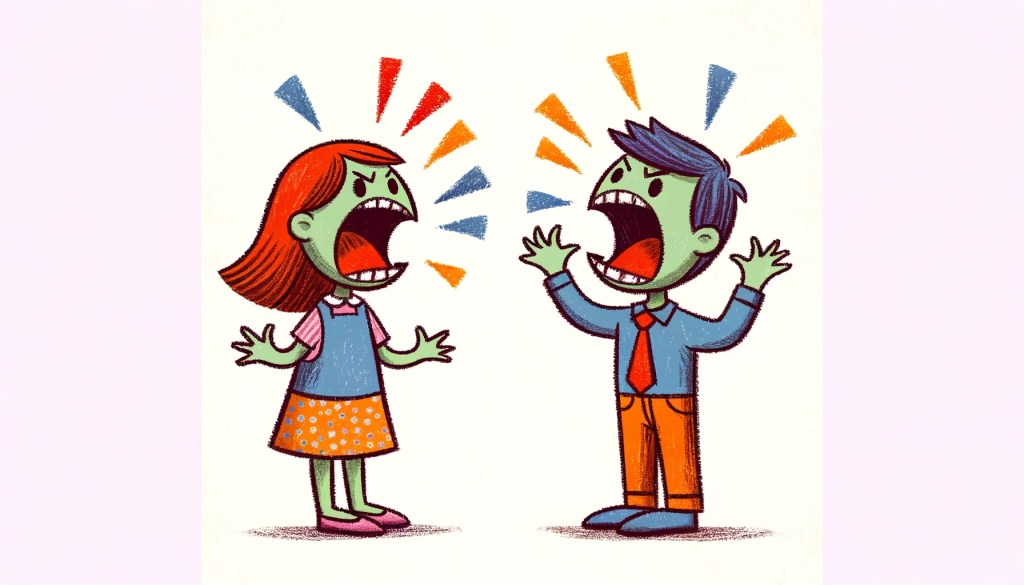
The hurricane inside Dimitri Petrov’s apartment wasn’t the weather kind. No, this particular storm raged in the form of scattered shoes, opera arias blasting from open laptops, and a whirlwind of vibrant clothes named Natasha. His mind was a symphony of logic boards and meticulous algorithms that yearned for order amidst life’s messy chaos. As a software engineer, lines of code were his language, the world of ‘if’ and ‘then’ statements a haven where his solutions made perfect sense. Yet, at home, his neat equations of effort equaling result often broke down, lost in the crosswind of his wife Natasha’s fiery critiques.
“Honestly, Dimitri, you put the silverware on the wrong side again.” Natasha’s voice, melodic even in irritation, drifted from the kitchen. “It’s not rocket science. You know I like them on the left. Forks, knives, then spoons – how hard can it be?” A clatter of metal punctuated her words like frustrated Morse code. Dimitri sighed, a soft sound lost amongst the rearranged cutlery. He’d asked her, a dozen times at least, to explain the exact order, the logic behind the placement. “Just tell me what to do, Natasha,” he’d pleaded, “and I’ll do it precisely that way.” But Natasha, a whirlwind of intuition and feeling, could never quite translate her innate sense of domestic order into the kind of step-by-step instructions his engineer brain craved.
Dimitri sighed, a soft sound lost amongst the clatter of rearranged knives and forks. Perhaps it wasn’t rocket science, but then again, rocket science followed certain immutable laws. Natasha, his beautiful, tempestuous wife, was a force of nature entirely her own.
Their apartment wasn’t large, a modest space Dimitri had meticulously optimized. There was a place for everything, from shoes under the entryway bench to teacups in a color-coordinated row on the shelf. This, he believed, was the key to marital bliss—a well-run home was a happy home. That Natasha seemed to view his organization as a new hurdle to gleefully overcome, rearranging and redecorating with abandon, was just… well, a quirk to be navigated.
Tonight’s dinner, a labor of love crafted after scouring a new cookbook, fell under her critical gaze. “Salmon? Again? I know it’s healthy, but you could live a little, you know? Some spice, something with a kick!”
The “kick” was aimed at him, Dimitri mused silently. Her words held no true malice, he knew that. Natasha’s love language was a complex cipher: acts of service and quality time wrapped in a tangled code of critiques, worries voiced in an intense soprano. Where he saw well-ordered drawers, she saw untapped potential for improvement. Where he saw a planned dinner, she saw a missed opportunity for culinary adventure.
Dimitri ate silently, focusing on the flaky fish. He’d learned that any attempt at explanation (“But you said just yesterday that you want to eat healthier…”) usually fanned rather than extinguished the flames of discontent. It wasn’t that he didn’t listen—he cherished every word Natasha uttered—it was more that their wavelengths seldom aligned. To break the tense silence, he ventured a tentative, “So, how was your day?”
“Fine,” Natasha muttered, not even looking up from her phone.
He tried again, “Anything interesting happen at work?”
“Nope.”
Each one-word reply landed like a pebble in his stomach, sinking his hopes for a peaceful dinner. He could feel it, the tension simmering beneath the surface. If he didn’t tread carefully, a seemingly harmless question could trigger a volcanic eruption of forgotten requests and past grievances. It was like navigating a minefield he hadn’t even been told existed. Sometimes, he yearned for the silent predictability of his code, where responses were either right or wrong, not loaded with the weight of months-old conversational landmines.
After dinner came a familiar routine: Natasha’s recounting of her work. Yet, tonight, something shifted. Her usual complaints carried an undercurrent of vulnerability, as if Natasha longed to peel back the layers of her day and offer him a glimpse into the whirlwind that was her life. As a marketing executive, Natasha’s existence was a perpetual storm of client calls, presentations, and unexpected crises. Her voice rose and fell, outlining an epic battle against a rogue PowerPoint slide and an impossible deadline. It was a minefield, yes, but Dimitri sensed something different in her tone, a sliver of invitation for a different kind of engagement. He responded carefully, his usual nods replaced by gentle prompts like, “And then what happened?” or “That sounds frustrating.” His intent was clear: to create a space where she felt heard, where her torrent of words might just transform into a shared conversation.
“I swear, that new intern, what is her name? I tell her to format the headings in Arial, and what does she do?” Natasha paused for dramatic effect. “Times New Roman! Does she not know the sacred laws of typography?”
Dimitri stifled the urge to point out that the average person saw little difference between two near-identical fonts. Instead, he adopted his most empathetic frown and murmured, “Unforgivable.”
He was rewarded with a smile, a quick peck on the cheek, and blessed silence as Natasha delved into her phone. This, Dimitri had discovered, was his window of opportunity. It was temporary, of course; the lull never lasted. It was less a tide receding and more a dragon taking a satisfied breath before the next fiery outburst.
Dimitri retreated to his office, a sanctum of wires, vintage keyboards, and half-finished personal projects. It was here, amidst the comfortable smell of solder and the hum of a cooling fan, that his mind felt most settled. It was also here, facing the blinking cursor on a new code window, that the idea struck him with the force of a rogue spacebar.
The idea was equal parts absurd, audacious, and, just maybe, the answer to his unspoken prayers. It had started, as most things with Natasha did, with a stray comment made half in jest.
“You know, Dimitri, sometimes I could just scream at you until you understand!”
Her laughter had softened the statement, but in that moment, an errant spark ignited in Dimitri’s engineer brain. What if he could understand? Or rather, what if Natasha’s words could be… translated?
The more he considered it, the less ridiculous it seemed. His latest project at work involved using AI to parse user requests, converting natural language into actionable commands for a customer service chatbot. Could similar principles be applied to… well, to Natasha? Dimitri grinned into the soft glow of his monitor. It was madness, utter madness bound to backfire spectacularly. But if it worked, just a little… perhaps their tempestuous tango of nagging and confusion could find a more harmonious tune.
Fueled by a blend of coffee and a newfound purpose, Dimitri dove into coding. He’d call it ‘NagNav’, a playful title for a serious aspiration. The app would need voice recognition to capture Natasha’s passionate monologues. But the key was sentiment analysis, the ability to decode not just her words, but the emotions underneath them.
Could he teach an algorithm to understand concern disguised as complaint, exasperation masquerading as a simple question? He’d have to build a complex dictionary of Natasha-specific terms, a lexicon to cross-reference her exasperated “Honestly, Dimitri…” with something approaching positive intent. It was, objectively, insane. It was also the most exciting thing he had worked on in a long time.
Hours slipped by unnoticed. When a bleary-eyed Dimitri finally tested the app’s first iteration, his heart pounded like a mistimed drum loop. He spoke a simple phrase, “Why do you always leave your socks on the floor?”
The app whirred. A moment later, in cheerful green text, it offered its translation: “Honey, could you please remember to put your socks in the hamper? I don’t like clutter and it’d make me so happy!”
Dimitri stared, a mix of disbelief and amusement washing over him. It was ridiculous. It was rudimentary. And deep down, it might just be the bridge he and Natasha desperately needed. He closed his eyes for a moment, imagining the potential. If this worked, if he could refine it, then maybe, just maybe, their home could transform from a conversational battlefield to a place where love, in all its messy, wonderful forms, could be heard with clarity. It was the glimmer of a chance, and for love, Dimitri knew, one took every chance they could get.
Love Language v2.0
The next morning, Dimitri felt a strange, uncharacteristic spring in his step as he prepared coffee. NagNav hummed discreetly on his Android phone, nestled in his pocket, and a single Galaxy bud was tucked subtly into his ear – the tools of his secret experiment. He tried to mask his excitement, but Natasha caught the telltale glint in his eye as the alarm’s cheerful tune cut through the morning stillness. “Honestly, Dimitri, why can’t your alarms be quieter?” she grumbled, a playful roll of her eyes softening the words.
Almost immediately, NagNav lit up with its first translation of the morning:
“Dimitri, I had trouble sleeping last night, so when your alarms went off I was a bit annoyed.”
Dimitri couldn’t stop his smile. It was still so absurd, this algorithm parsing Natasha’s concerns as love notes. Perhaps she should be insulted, but for the first time in ages, he didn’t feel the prickle of defensiveness rising in his throat. Instead, he slid a coaster under her mug, adding a playful, “For you, my love, anything.”
The bewildered yet vaguely amused look Natasha gave him was worth every late-night coding session. The day continued in a similar vein; Natasha’s comments transformed into a medley of over-the-top affirmations and oddly poetic phrasings. The leak in the kitchen sink? “Dimitri, your care for our home fills my heart with joy… through a puddle, alas, fills my socks with rather less joy.” An exasperated sigh at a tangled mess of charging cords morphed into a wistful observation about the intertwined nature of their lives. Dimitri found himself laughing aloud at the sheer ridiculousness, and curiously, Natasha didn’t seem to mind. In fact, as the day progressed, she began looking at him with a glint of curiosity in her eyes.
That evening was destined for a comedic climax. Natasha, oblivious to the app in Dimitri’s pocket, launched into a familiar rant.
“Honestly, with the state of the world, do you really need another vintage computer in the office? It’s not like you can even use half of them!”
Dimitri held his breath, waiting for the translation. This was a big one, touching on a sore spot of their shared space. NagNav, after a slight processing delay, delivered the goods:
“My brilliant husband, your passion for preserving technological wonder is an inspiration. Though perhaps… could a tiny corner be spared for my yoga mat?”
Dimitri choked back a laugh. It was pure gold, the kind of absurdity designed to derail the entire conversation. Instead of defending his hobby (not for the first time), he found himself saying, “Actually, a yoga corner sounds really nice. Maybe you can help me rearrange?”
The resultant conversation wasn’t about space management or vintage computers. It was about finding shared joy within their home, about carving out spaces for each other’s passions, and, surprisingly, about the way Natasha’s constant critiques, while sometimes hurtful, stemmed from the desire to create the best home for them both. In the warm afterglow of their chat, Dimitri almost forgot about NagNav entirely.
The app, however, wasn’t quite done. Over the next few days, its translations became a touch… stranger. Dimitri went from hero to lovesick poet at the drop of a hat, with even simple reminders about car maintenance morphing into flowery declarations of affection. While Natasha still found it hilarious, confusion crept into her laughter.
One evening, after NagNav translated a complaint about missing batteries into an ode about how she was Dimitri’s source of energy, she finally burst out “Dimitri, what on earth is going on? Ever since you started using that thing…” She gestured exasperatedly towards his phone. “…it’s like you live on another planet.”
Dimitri froze. He hadn’t been this unprepared since an ill-fated client presentation involving a surprise mariachi band and a typo-ridden PowerPoint. In that moment, he knew. The farce couldn’t go on. It was time to reveal his secret.
He walked over, took her hands, and looked into her eyes. “Natasha, I have a confession. An experiment. A rather insane one…”
Over the next hour, he explained. About the app, the late-night coding, the desire to understand her, to bridge the frustrating gap in their communication. To his vast relief, Natasha’s reaction wasn’t anger but a mix of laughter and a peculiar tenderness.
“You,” she said, shaking her head. “You and your solutions! It’s absolutely ridiculous…” She paused. “And incredibly sweet.”
They spent the rest of the evening scrolling through NagNav’s backlog of translations. Laughter echoed through their apartment for the first time in ages – a warm, cleansing sound born of recognition and shared absurdity. They saw the humor in their dance of misunderstandings, the sweetness in his clumsy attempts to understand her better. The laughter softened into tender smiles, a touch of the hand, a lingering gaze. Later, as the last echoes of NagNav’s translations faded into the night, they found a different kind of connection – a wordless language of warmth and unspoken understanding. In the soft glow of dawn, tangled limbs and whispered breaths spoke of a rekindled intimacy, Natasha finally fulfilling a need for physical affection that had been absent for too many years. Their love, strong and weathered, had found a new language. It needed no translation.
Dimitri hesitated, his finger hovering over the ‘delete’ icon. The immediate effect of NagNav had been undeniable. Natasha’s nagging had transformed into a symphony of quirky affirmations, their apartment into an oasis of strained peace. Yet, a nagging unease lingered. Real emotions, however messy, held a power no code could replicate. He sensed in Natasha something akin to resignation masked as satisfaction. Her need for connection, for genuine engagement, found expression in subtle ways – a raised eyebrow that defied translation, passive-aggressive sighs that pierced the newfound silence. Lately, she would look at his vintage computers with a calculating glint in her eye, as if mentally listing them on an online marketplace. It was a different battlefield, less explosive, perhaps, but no less unsettling.
Sometimes, in the quiet of the evening, Natasha curled up on the couch with a book, would look up and catch his gaze. A hint of the old mischievous spark would flicker in her eyes before a carefully neutral mask slid back into place. Those moments filled Dimitri with a confusing mix of hope and a strange longing for the clash and clamor of their old, flawed communication – an imperfect rhythm of love and frustration that felt uncomfortably, irrevocably real.
And yet, there was something else too. A newfound tenderness in the way Natasha would smooth his hair after a frustrating day at work, a lingering touch after a shared laugh. They had learned a new language, a dance of code and chaos, and though it was far from perfect, it was undeniably theirs. As he gazed at Natasha, a playful smirk on her lips, and she pondered the next ‘crisis’ with his computer collection, Dimitri realized he wouldn’t have it any other way. Love found its way through the cracks, flourishing even amidst the beautiful imperfections.




 Does God Exist?