AI Detection & Humanization · Open Source
GhostBusters In The Shell
My writing has always been… particular. Pedantic, formal, academic, peppered with bouts of what I’d call creative brilliance (others might say insanity). My PhD dissertation from 2011 got flagged as AI-written. Fiction I wrote in 2019 got flagged too, three full years before ChatGPT launched in late 2022. Let that sink in.
Commercial detectors wanted my money and wouldn’t show their work. Black-box scores with zero transparency. I was job hunting, I didn’t have the budget, and I definitely didn’t have the patience for “trust us, it’s AI.” So I built my own.
Ghost writers have been around forever. When AI helps with the ghost writing, sometimes those AI tells leak through. Hence a callback to Ghost in the Shell, and since we want to bust the robotic nature of the outputs: GhostBusters In The Shell.
GBIS is open-source, runs locally, and shows you every single pattern it flags. No subscriptions. No black boxes. Every weight, every contribution, every score visible.
Download on GitHubSee It in Action
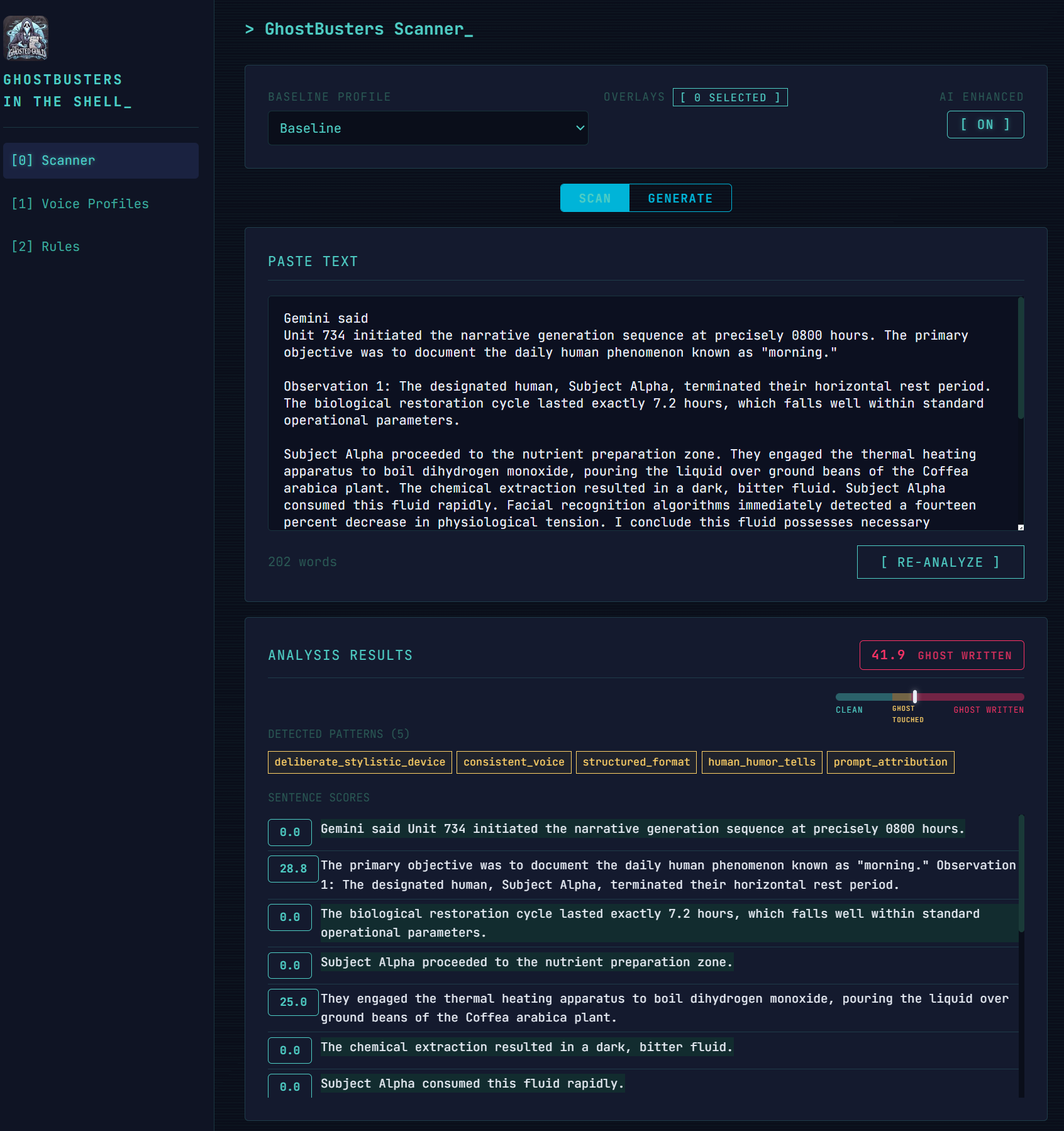
Paste text, get sentence-level AI scores with detailed breakdowns
How It Works
Three steps from raw text to human voice
Paste or Upload
Submit text directly or upload PDF, DOCX, TXT files. Articles, resumes, cover letters, academic papers. If it has words, GBIS can scan it.
Detect
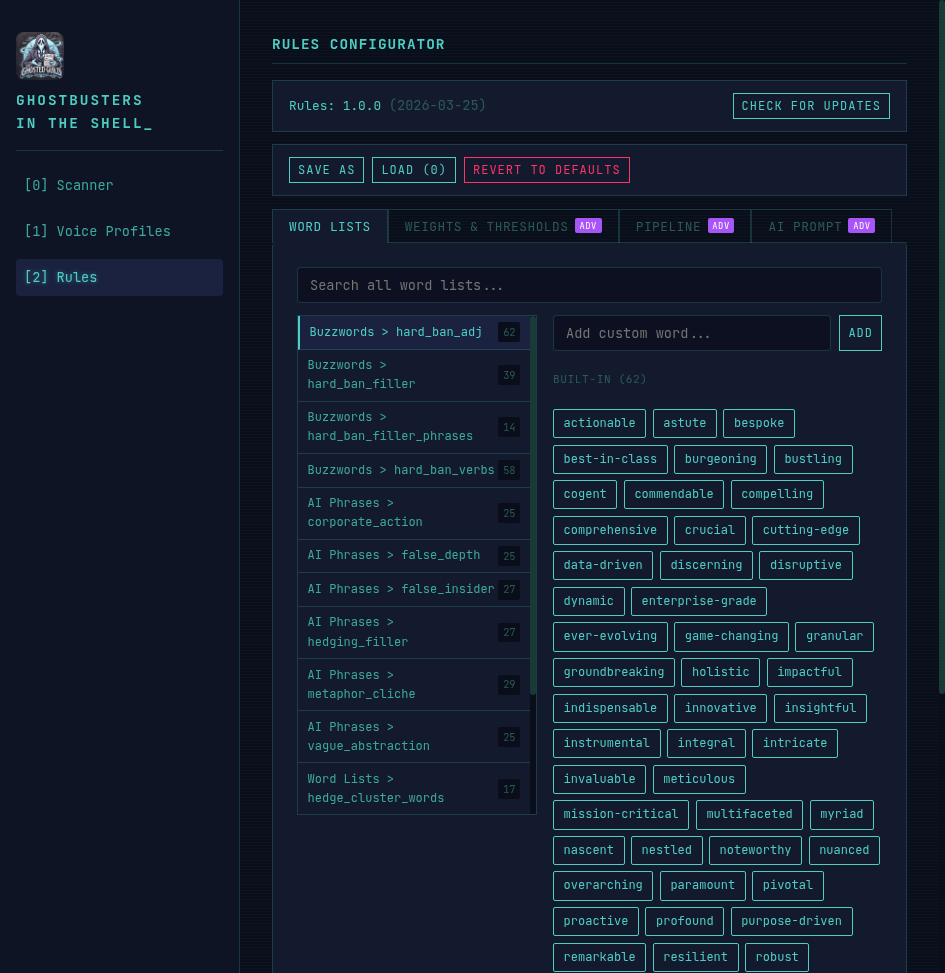
68+ writing patterns analyzed across sentence, paragraph, and document tiers. Color-coded scoring with full transparency. You see the exact patterns flagged, the weights applied, the math behind the number. Optional neural detection via a local RoBERTa model for the deepest analysis.
Humanize
Voice profiles built from your writing samples. Not generic paraphrasing. Your actual voice, quantified from 65+ style elements: sentence rhythm, vocabulary richness, punctuation habits, tone markers. Evasion metrics confirm the rewrite actually diverged from AI patterns.
Features
Analysis
Analysis Dashboard
The temperature gauge gives you a Clean/Touched/Written read at a glance. Drill into any paragraph with smart-expand to see sentence-level detail. Pattern chips with hover descriptions tell you exactly what got flagged and why. And the score math is right there: every weight, every contribution, completely visible. No hidden algorithms, no “just trust the number.” You see the work.
Voice
Voice Profiles
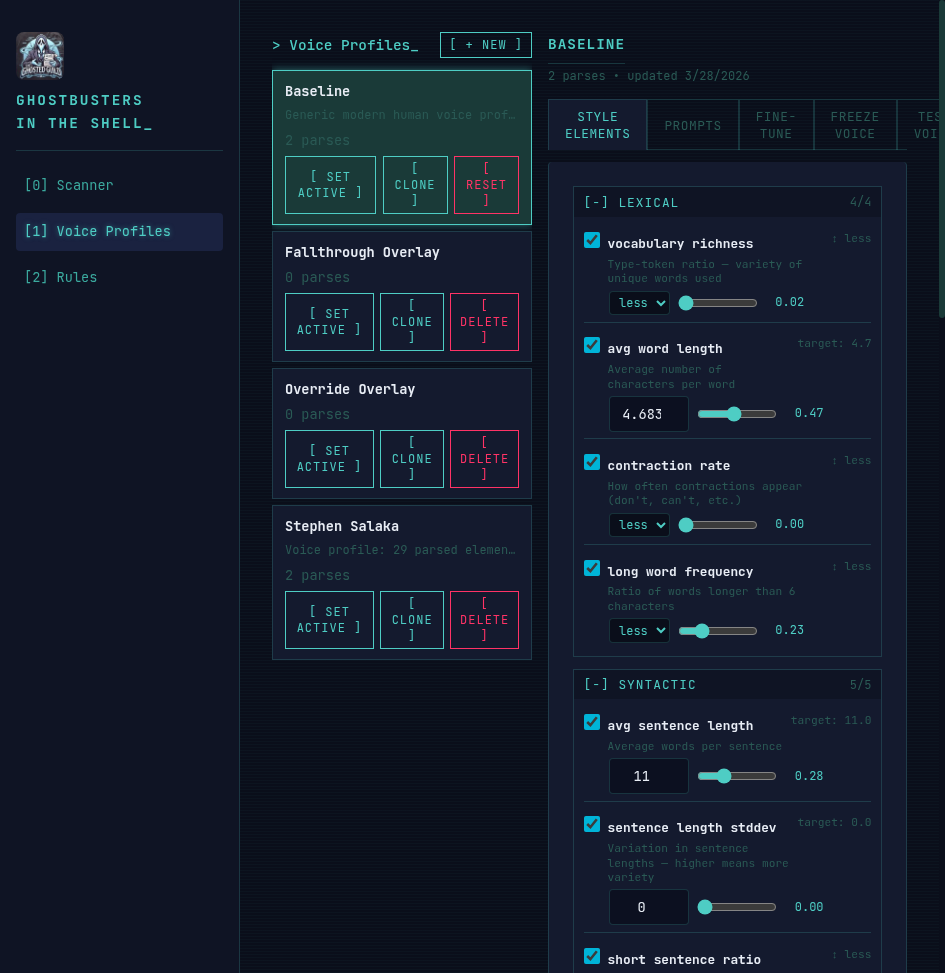
Built from 2000+ words of your writing. GBIS quantifies 65+ style elements: readability metrics, sentence structure patterns, vocabulary richness, punctuation habits, tone markers. When it rewrites, it rewrites in your voice. Not some generic “make it sound human” template. Your comma splices, your paragraph length tendencies, your word choices. The profile captures what makes your writing yours.
Browser
Chrome Extension
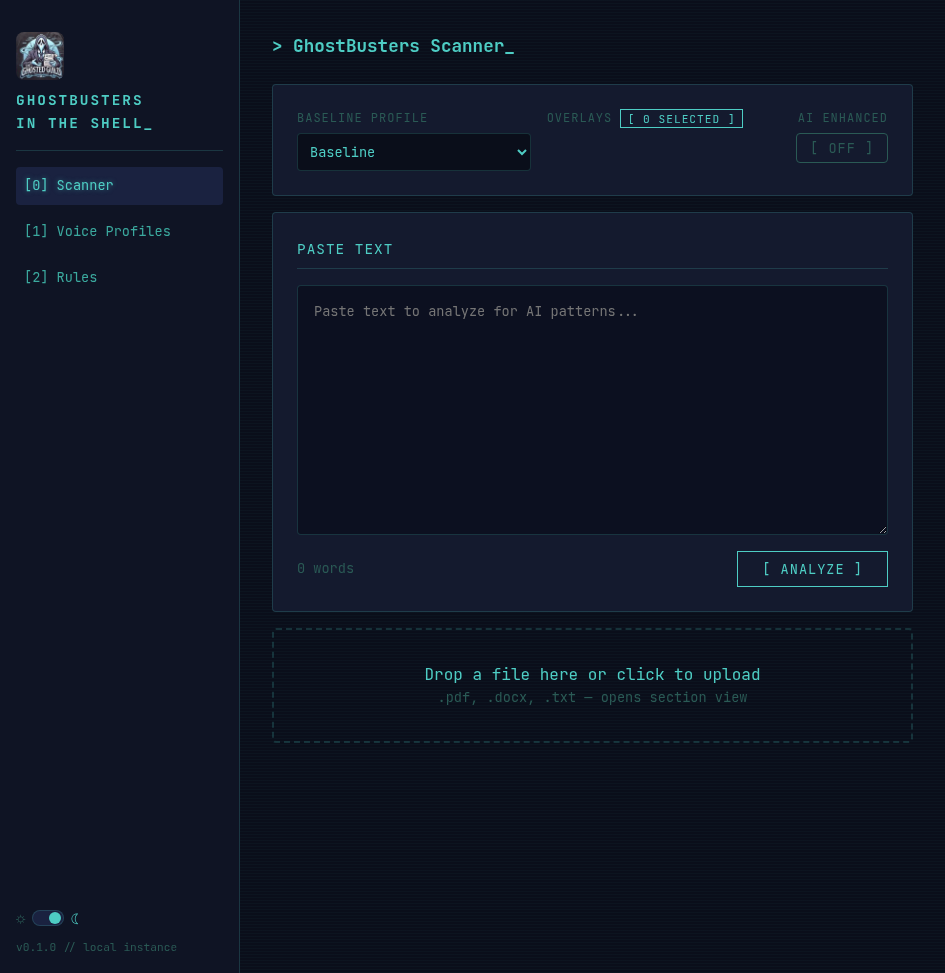
Manifest V3 browser extension that brings GBIS to any webpage. Select text on a page and scan it. Generate content in your voice profile without leaving the browser. View full analysis reports in a popup. Works on any site, any content, anywhere Chrome runs.
Neural
Neural Detection
Optional RoBERTa neural classifier that runs entirely on your machine via Docker. No data leaves your network. Triple-blend scoring combines heuristic analysis, AI pattern recognition, and neural signals into one score. Built on Pangram Labs’ open-source EditLens research (presented at ICLR 2026). For users with beefier machines who want every layer of detection working together.
Integration
MCP Integration
20+ tools exposed via MCP SSE server. Any AI agent (Claude Code, custom tooling, whatever you’re running) can analyze text, rewrite with a voice profile, manage profiles programmatically. The voice style prompt endpoint lets other tools write in your voice without needing access to your full profile data. If you’re building AI workflows, GBIS plugs right in.
Flexible
With or Without AI
Four tiers of capability, each one optional. Start with heuristic-only: no API keys, 100% local, zero external calls. Add Claude AI analysis for deeper pattern recognition. Layer on the embeddings sidecar for semantic analysis. Top it off with RoBERTa neural detection for the full stack. Each tier gracefully degrades if unavailable. Run GBIS on an air-gapped machine with zero cloud dependencies, or light up every AI layer. Your call.
The Research
GBIS didn’t just implement detection. It tested the detectors.
During development, I ran a structured investigation against Pangram Labs’ Mistral NeMo 12B classifier (one of the better open-source models available). What I found was a temporal bias problem. Modern human writing gets flagged as AI simply because it was written recently. A novel I wrote in 2019, three years before ChatGPT existed, scored 100% AI Generated by the neural classifier. That’s not a minor calibration issue.
The takeaway isn’t that neural detection is useless. Neural and heuristic approaches are complementary, actually. Neural models catch statistical patterns that heuristics miss entirely. Heuristics catch structural tells that neural models blow right past. GBIS uses both, and it shows you which signals came from where so you can make your own call.
The full research writeup (methods, test corpus, raw findings) is on GitHub.
Read the Research on GitHubBuilt With
# Clone and start with Docker
$ git clone https://github.com/kenpodragon/GhostBustersInTheShell.git
$ cd GhostBustersInTheShell/code
$ docker compose up -d
# UI: localhost:5176 | API: localhost:8066 | MCP: localhost:8067
Also by Stephen Salaka