
Leadership Bytes for Coders
Goodbye bug squashing, hello people problems! Your guide to navigating the tech-to-leadership transition.

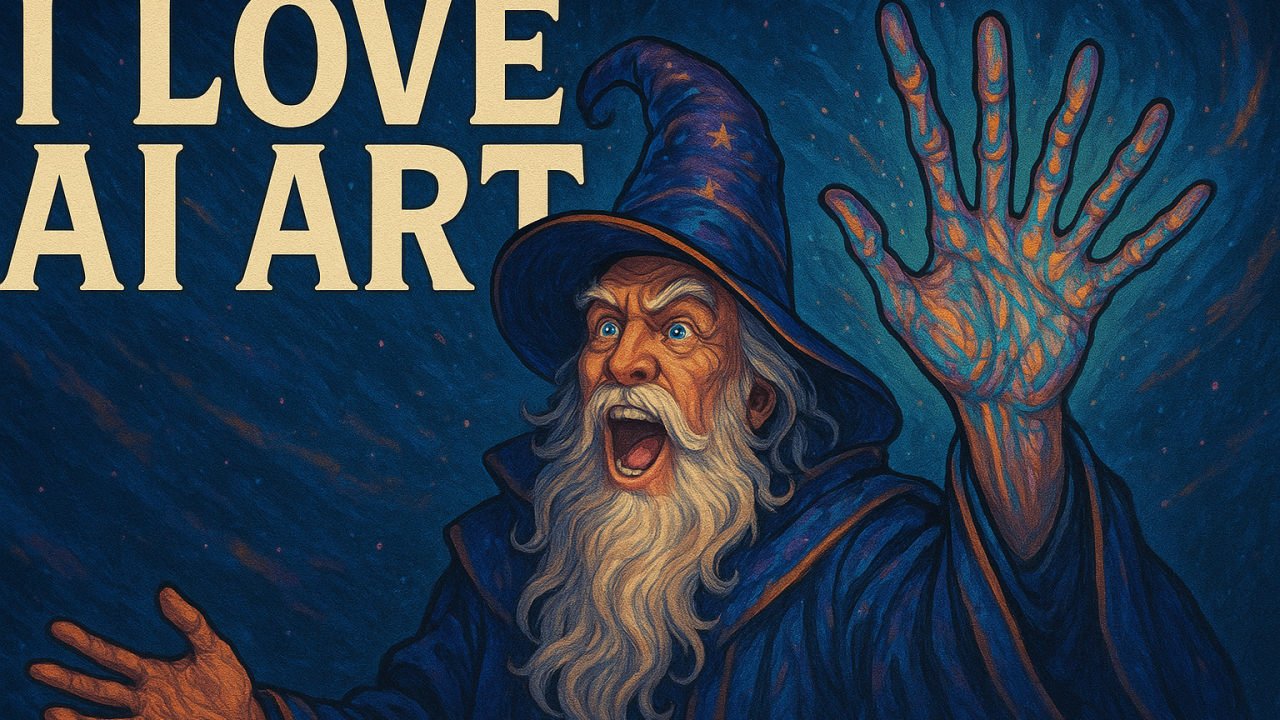
I Love AI Art
Created on 2025-06-12 16:05
Published on 2025-06-12 16:57
Why? Because AI is the new gateway drug into doing art.
I know my creative friends out there are about to burn me at the stake for saying this, but stick with me.
It’s 4,500 BC somewhere outside of Eridu. You’re a young shepherd grazing your flock against the banks of the Euphrates. In the sky you see a huge orange fireball, followed by a sudden rise in the river level.
You rush to bring your flock back to your hut, then make your way to the bar.
“I saw something fall from the sky, and then the river rose,” you say.
“It does that all the time,” some other drunk peasant says.
So for the rest of your life, whenever you were modestly inebriated, you tell your little story, before slinking back off alone to the comfort of your sheep.
One night, some traveling minstrel overhears your story.
In the next tavern, they start telling the tale of “The gods struck the earth and she wept. But no one listened to the chicken. So the gods struck the earth again. And still no one listened. Finally one day, everyone was out in the field, the chicken cried as loud as they could, and saved the village and everyone lived happily ever after.”
Chicken Little still lives to this day. Yet no one credits the poor shepherd who died alone with their sheep.
The Two Kinds of People
There are two types of folks in this world. The creatives, and everyone else.
That’s not to say that non-creatives can’t train and be creatives. Fingerpainting, slam poetry, etch-a-sketch, and the signature Bob Ross painting little trees packages for lonely ladies… these are all bridges. Ways for people to dip their toes into the creative waters.
And now AI.
The shepherd had a vision. Something real, something worth sharing. But they lacked the tools, the platform, the craft to make anyone listen.
The minstrel? They had the tools. They knew how to shape a story, how to make it stick, how to carry it forward.
For thousands of years, we’ve had shepherds with visions and minstrels with craft. The distance between them has been vast… resources, training, time, access.
The Great Flood
Let’s get the uncomfortable part out of the way first.
Yes, AI is going to depress a lot of opportunities for creatives by driving the cost of producing “pulp art” down to the lowest common denominator.
But these opportunities aren’t going to just some random dude in a corner office typing prompts into a keyboard every day. They’re going to other creatives who’ve started to embrace the new technology as an extension of their art.
Making art still requires creativity and imagination, as well as an understanding of aesthetics and presentation. And while some places might be using random art as “good enough,” others are wanting the best. So their creatives are using AI to rapidly generate options for the non-creatives to review… and then up-arting those artifacts to make the final product.
You’ve forgotten what it felt like to be five years old, haven’t you?
Remember that afternoon when you burst through the front door, construction paper clutched in your small fist. “Mom, look!” The pride radiating from every fiber of your being as you held up that sloppy scribble… tornado lines and smudged crayon everywhere. “It’s a lion.”
She squinted. Tilted her head. Most adults just pretended to see your lion in that beautiful mess. But you? You saw that lion clear as day. Magnificent. Roaring.
Some of you got lucky. Supportive parents. Art supplies that didn’t break the family budget. Teachers who saw potential instead of problems. You kept drawing. You practiced. Years of lions until you could draw them so real they seemed ready to leap off the page.
The rest of us? We got laughed at.
“That doesn’t look like anything.” “Stop drawing those stupid scribbles.” “Just stick to what you’re good at.”
So we died a little inside. We put away our crayons and turned to safer things. But we never stopped seeing lions in our heads… we just lost the tools to set them free. While you were in art class perfecting your craft, we were watching from the hallway, envious and ashamed.
For decades, that divide held firm. Art belonged to those who could afford the time, the training, the years of practice. The rest of us made peace with our inner lions staying caged.
Then AI arrived.
Suddenly, anyone can extract those creatures from their imagination with a few keystrokes. Finally, after forty years of silence, those lions can roar again.
But when you dismiss their enthusiasm as “AI slop”… when you roll your eyes at their first attempts… you’re not protecting art. You’re the kindergarten bully all over again, laughing at the scribbles.
You’re gatekeeping creativity behind skill and resource barriers that most people will never have the luxury to overcome. Try practicing art when you’re working three jobs and caring for sick parents. Try finding time for life drawing classes when every spare moment is juggling kids.
What AI has done is simple. It’s given every shepherd a minstrel’s toolkit.
And for the first time in human history, the lions in their heads finally have a way out.
The Tide Recedes
Even with all the easy access AI slop, though: Most folks just aren’t that creative, nor wish to be.
AI for them is a novelty. Remember 2 years ago when every second post was some random grandma praising poorly done AI images?
Yeah, that quickly got old.
After producing a dozen or so AI images, the only thing they got was visciously mocked about “AI not being real art”. Suddenly they were back in kindergarten, re-living their nightmares all over again, bringing back a flood of memories they’ve tried to repress.
99.9% of them went back to doing whatever else non-creative bits they do and canceled their Midjourney subscriptions.
Looking back, it’s not the first time technology made it easy for folks to be creative.
It’s not like minstrels were few and far between. For every shephard there was a minstrel willing (when paid) to tell the story.
We’ve had ghostwriters forever… some will even work for just royalties, others aren’t that expensive. Decades of surveys show that 92% of people want to write a book, yet only 1% ever do, despite having all these tools at their disposal.
Enter AI and the rise of AI-generated story slop.
“ChatGPT write me a story about two people who are vampires and then fall in love but then are secretly a werewolf.”
“Hey everyone look at my new book I just wrote.”
“Why aren’t people reading my book I just published on Amazon Kindle? Why is it only getting one stars?”
People soon realize it’s not just writing—it’s pacing, editing, marketing, audience. The fun part fades. The grind sets in. That being creative takes brain power and imagination that soon dries up. The novelty wears off and starts to feel less like fun and more like work.
And so they’re stopping.
The initial flood of “AI Novels” pretty much drowned out most books written these past 2 years.
The slop flood is finally receding. Fewer “why isn’t my AI slop book selling” posts. Fewer one-click masterpieces.
Yes, slop is still there (for sure). And yes companies are gloming onto it like it’s white on rice. It’s just someone’s forgotten to turn off the posting bots.
The True Minstrels Emerge
The thing is, most shepherds have only ever wanted to try on the minstrel’s hat. They sang a verse or two, got booed, and went back to tending sheep. That’s fine. Not everyone wants to tell stories.
But some? They kept singing.
For a few brave souls, AI is more than a novelty. They’ve rediscovered ART and their creativity.
They re-posted their first “lion” scribbles. It’s easy and cheap enough now that they are encouraged to get better. So they start practicing. They get a lot better at prompting. They might not be sketching in the classical sense, but they’re picking up concepts of perspective, compositing, and lighting. They’re starting to understand aesthetics.
They’re continuing to post despite the backlash folks who hate AI are creating. Why? Because they’re ARTISTS and they’re sharing their ART.
And they’re starting to get really good. So much so it’s also a factor in discouraging others from posting their scribble slop anymore.
Some AI artists have even using this as an impetus to start actually drawing their own original designs, and using AI to enhance them. The coolest thing is that AI is going to create a whole new genre of art, and I can’t wait to see what innovators are able to do with these new tools.
These are the shepherds who found their voice. Who discovered that what they saw in the sky was worth sharing… and now they have the tools to make people listen.
At the end of the day, a computer is not a creative. It’s not going to randomly imagine Mickey Mouse punching Darth Vader. It still needs that human spark of imagination to get going. Yes, it makes the creation of that image a lot easier… but it’s a human, a creative, at the other end guiding this TOOL in making the ART (plus all the work going into refining that image to make it perfect).
The New Legends
Easy art sucks for those who’ve spent lifetimes honing their craft. Years of practice, sleepless nights, calloused fingers. Your style is unmistakable… galleries know your work from across the room. All that work should be celebrated.
But even skill can be commoditized. Imagine some savant walks into your gallary and mimics everything you do.
It stings. Maybe you tell yourself imitation is flattery. Maybe you rage. Either way, there’s not much you can do unless they’re stealing your exact pieces.
Now imagine a world where everyone became that savant overnight. Where your decades of training could be replicated with a few typed words. That’s what we’re living through. The barriers to creation are crumbling like ancient walls.
And it feels like a slap in the face because it is!
But here’s what the old minstrels knew that we’ve forgotten.
Tools don’t make legends. Stories do.
It’s the same reason why we don’t see paint by numbers hanging in national art galleries. Most folks got them, did some “art”, and then lost the books and paintbrushes in junk drawers somewhere. The slop will fade, is fading, in the same way… most of it already is. Because creating isn’t just about having the tools. It’s also about having something worth saying.
Our shepherd didn’t become legend because he saw the fireball. Hundreds probably saw it that day. It was the minstrel that made him into one because someone recognized the truth in his vision and knew how to make it sing.
The AI shepherds emerging now? They’re not just using tools. They’re becoming their own minstrels. They’re learning to see what others miss, to shape what others ignore, to tell the stories that need telling.
And someday, thousands of years from now, when archaeologists dig through the digital ruins of our age, they won’t remember the drunk peasants who mocked the new shepherds and their spiral drawings of “lions”.
They’ll remember the legends those minstrels created.
The fireball has already fallen. The river is rising.
The only question left is whether you’ll be the one telling the story… or the one sitting in the corner, laughing at visions you’re too afraid to see.
// COMMENTS