
Leadership Bytes for Coders
Goodbye bug squashing, hello people problems! Your guide to navigating the tech-to-leadership transition.

Management by Squirrel: Why Leadership Loves Chasing Nuts
Created on 2024-06-07 15:53
Published on 2024-06-07 16:31
There’s an interesting phenomenon in the tech world. Once upon a time, when we were driving innovation, people praised us for being on the leading edge. Then, as business folks got their hands on the term, it morphed into the cutting edge. But that still didn’t sound aggressive enough for the suits, so now they call advancements in tech the bleeding edge. I suppose it makes sense, considering how business leaders often bleed the dev staff dry in their relentless pursuit of the next shiny thing.
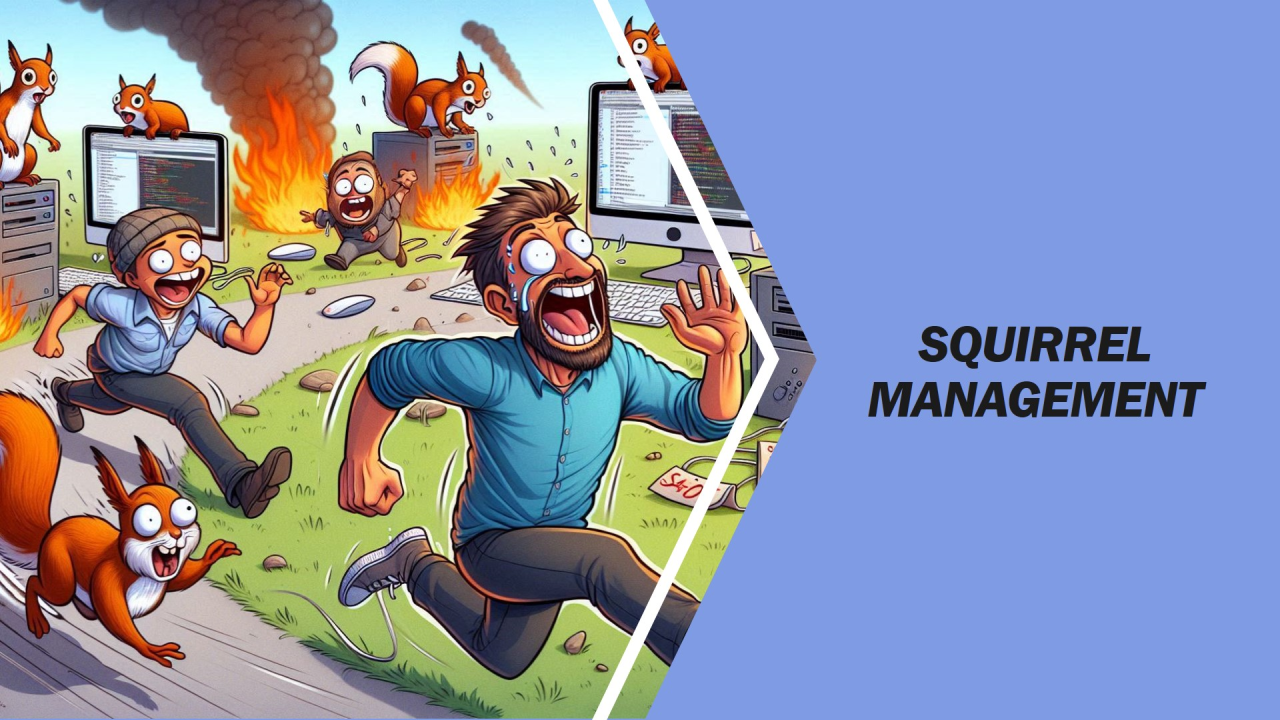
We, in the trenches, have a name for this phenomenon: Management by Squirrel. If you’ve ever watched a squirrel, you’ll know how it flits from one distraction to the next, barely finishing one task before something else catches its eye. This metaphor aptly describes the constant shifting of priorities we see in tech, driven by business leaders chasing clout and the latest industry trends. In the past few years, we’ve seen data science take center stage, only to be overshadowed by the rise of GenAI. What’s next? Who knows what monsters the Frankensteins in the business world will dream up next?
Unfortunately, the only constant in tech is change, and over the years, we’ve developed thick skins dealing with it. Today, I want to delve into this concept of business leaders chasing the next shiny thing and, more importantly, discuss what you, as a tech leader, can do to help insulate your teams against the Demogorgon.
New Tech: All That Glitters Isn’t Code
First, let’s talk about the allure of the next shiny thing. Whether it’s blockchain, AI, or quantum computing, each new technology promises to revolutionize the industry. The excitement is palpable, and business leaders, eager to capitalize on the latest trend, often push for rapid adoption. However, this rush often leads to half-baked implementations and overworked teams.
As tech leaders, it’s our job to temper this enthusiasm with a dose of reality. When presented with a new technology, ask critical questions: Does it solve a real problem we have? Is our team equipped to handle it? Do we have the resources to implement it properly? By asking these questions, we can ensure that we’re not just jumping on the bandwagon but making strategic decisions that benefit our organization in the long run.
From Visionary to Vaporware: The Perils of Clout Chasing
In the race for recognition, many business leaders fall into the trap of chasing clout. They want to be seen as innovators, disruptors, and visionaries. While there’s nothing wrong with ambition, this often leads to a focus on style over substance. Projects are launched with great fanfare but lack the necessary follow-through, leaving teams scrambling to pick up the pieces.
To counter this, emphasize the importance of sustainable innovation. Highlight the need for thorough planning, realistic timelines, and incremental progress. By setting clear expectations and demonstrating the value of a measured approach, you can help steer the focus away from chasing clout and toward achieving meaningful results.
Trendspotting: Keeping Up with the Tech Kardashians
Keeping up with industry trends and top stories is essential, but it’s also a double-edged sword. On one hand, it ensures that we’re aware of new developments and can leverage them to our advantage. This awareness can lead to innovative solutions and keep us competitive in a rapidly evolving field. However, not all squirrel chasing comes from external pressures; some of it is self-inflicted. Developers often chase after the newest coding languages, believing them to be the ultimate solution to modern programming challenges. For instance, the current buzz around the Rust programming language has some developers arguing to replace entire codebases with it. While Rust offers numerous benefits, such as memory safety and concurrency without data races, this enthusiasm can sometimes overshadow practical considerations.
The excitement around Rust highlights a common pitfall in tech: the tendency to jump on the bandwagon without fully understanding the implications. Advocates for switching entire codebases to Rust often fail to consider the language cycles that have historically shaped our industry. Additionally, with the advent of AI automation in development, the effort and resources required to switch now might result in limited returns. In a few years, AI-driven tools could significantly streamline coding processes, rendering today’s extensive rewrites less valuable. As new languages and technologies continue to emerge, capturing the interest of the next generation of developers, they, too, will likely push to replace existing systems with the latest tools. This perpetual cycle of upheaval and adaptation can be detrimental, causing instability and preventing teams from mastering any one technology before moving on to the next.
To strike a balance, it’s crucial to encourage a culture of continuous learning within your team. Promote regular knowledge-sharing sessions, attend relevant conferences, and subscribe to industry publications to stay informed about the latest trends. However, this should be paired with fostering critical thinking. Teach your team to evaluate trends critically, considering their long-term implications and the context of your organization’s specific needs. By doing so, you’ll build a team that’s both informed and discerning, capable of making strategic decisions rather than reacting impulsively to every new development. This approach will ensure that while your team remains at the cutting edge of technology, it does so in a way that is sustainable and aligned with your broader goals.
Not Every Day is a Tesla Demo: The Unseen Grind of IT
Speaking of Rust – The buzz was palpable leading up to the unveiling of the Tesla truck. The tech world was abuzz with speculation and anticipation. ELON MUSK, ever the showman, had promised something revolutionary, a game-changer in the realm of electric vehicles. On the night of the big reveal, the atmosphere was electric with excitement. Crowds gathered, and millions tuned in online to witness what was touted as the next big leap in automotive innovation.
As the sleek, futuristic truck rolled onto the stage, the audience erupted in applause. Musk took center stage, exuding his trademark confidence. The highlight of the night was supposed to be a live demonstration of the truck’s purportedly bulletproof glass. With a dramatic flourish, Musk invited Tesla’s lead designer, Franz von Holzhausen, to put the glass to the test by throwing a steel ball at it. The crowd held its breath.
And then, it shattered.
The steel ball destroyed the supposedly indestructible glass with a resounding smash, leaving Musk visibly flustered. Despite attempts to play it off as a minor hiccup, the moment quickly became a viral sensation. Memes flooded the internet, and the botched demo overshadowed the rest of the event.
The world of IT isn’t always as glamorous as a Tesla truck bulletproof glass demonstration. For every high-profile success, there are countless behind-the-scenes efforts that go unnoticed. It’s easy for business leaders to get caught up in the spectacle and overlook the hard work that makes it possible.
As a tech leader, it’s your responsibility to shine a light on these efforts. Celebrate small wins, acknowledge the contributions of your team, and make sure that their hard work is recognized. By highlighting the importance of these often-overlooked tasks, you’ll foster a culture of appreciation and motivation.
Behind the AI Curtain: Math, Data, and No Wizards
AI is the latest shiny object that has captured the imagination of many business leaders. And yes, AI is awesome. It has the potential to transform industries, streamline operations, and create new opportunities. However, it’s essential to demystify AI and remind everyone that behind the magic, it’s all just math and a need for clean data.
Educate your team and stakeholders about the realities of AI. Explain the importance of data quality, the challenges of implementation, and the need for ongoing maintenance. By setting realistic expectations, you’ll ensure that AI projects are approached with the necessary diligence and that their potential benefits are fully realized.
Demogorgon Defense: Keeping Your Team Sane
So, how do you insulate your team against the Demogorgon of Management by Squirrel? Here are a few strategies:
-
Prioritize Ruthlessly: With so many potential projects vying for attention, it’s crucial to prioritize ruthlessly. Focus on initiatives that align with your strategic goals and have the highest potential impact. Be prepared to say no to projects that don’t meet these criteria.
-
Foster a Culture of Focus: Encourage your team to concentrate on their core responsibilities and avoid distractions. Set clear goals and provide regular feedback to keep everyone on track. Create an environment where deep work is valued and interruptions are minimized.
-
Develop a Roadmap: Create a roadmap that outlines your long-term vision and the steps needed to achieve it. Use this roadmap as a guide to evaluate new opportunities and ensure that they align with your strategic objectives.
-
Communicate Transparently: Keep your team informed about the reasons behind your decisions and the broader context of your initiatives. Transparent communication builds trust and helps everyone understand the rationale behind prioritization.
-
Build Resilience: Change is inevitable, but resilience can be built. Invest in training and development to equip your team with the skills they need to adapt to new technologies and challenges. Foster a growth mindset and encourage continuous improvement.
-
Champion Innovation: While it’s important to avoid chasing every shiny object, it’s equally important to foster a culture of innovation. Encourage your team to explore new ideas, experiment, and learn from failures. Create a safe space where creativity is valued and supported.
Management by Squirrel is a real challenge in the tech world. As business leaders chase the next shiny thing, it’s up to us, the tech leaders, to provide a steady hand and guide our teams through the chaos. By prioritizing ruthlessly, fostering a culture of focus, developing a roadmap, communicating transparently, building resilience, and championing innovation, we can insulate our teams against the Demogorgon and ensure that we continue to drive meaningful progress in the ever-evolving world of technology.
Remember, the key to success is not in chasing every new trend but in making strategic decisions that align with your long-term goals. By doing so, you’ll create a sustainable path forward and lead your team to success in the face of constant change.

// COMMENTS