
Leadership Bytes for Coders
Goodbye bug squashing, hello people problems! Your guide to navigating the tech-to-leadership transition.

OOP is Dead. Long Live OOP
Created on 2024-03-27 18:05
Published on 2024-03-27 18:11
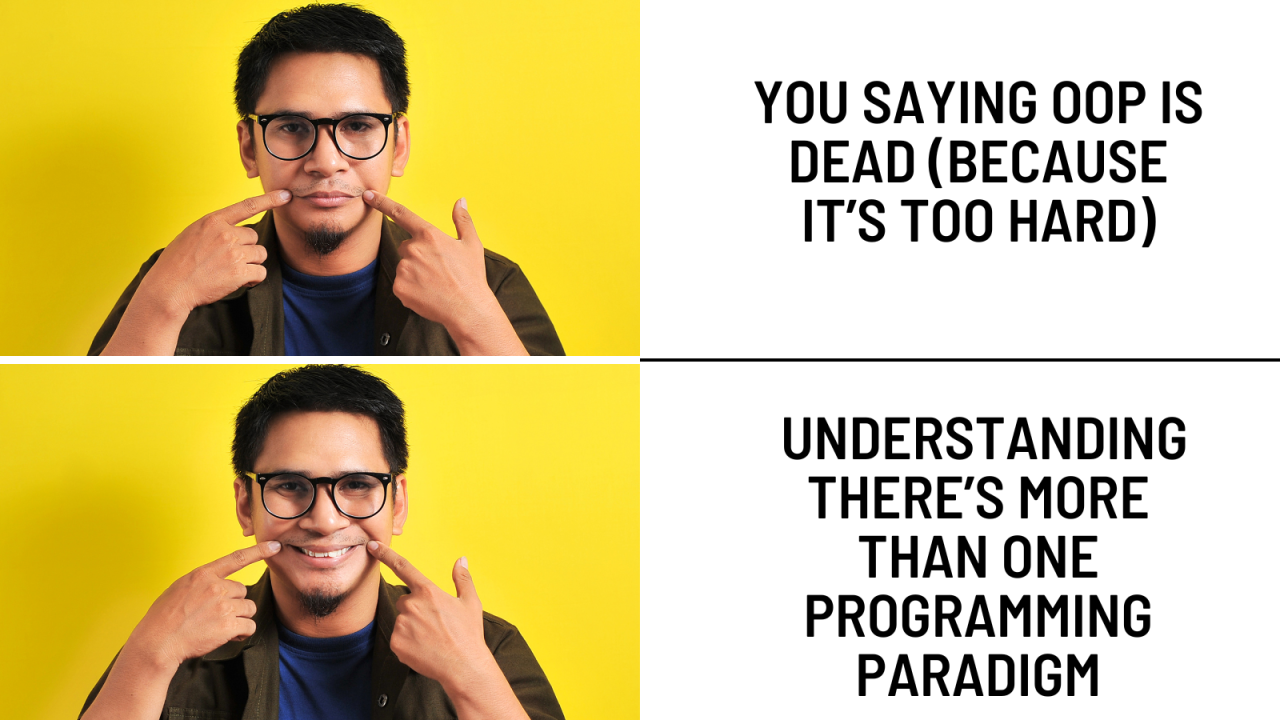
Let me start this whole thing off with a confession: I secretly love the “OOP is Dead!” debates that keeps flaring up online like clockwork. Why? Because I hire software engineers, and these little flame wars are a great litmus test. Anyone who jumps into that ring with absolute, unbending certainty about the superiority of one programming paradigm over another is likely not someone I want on my team.
You see, I studied Computer Science (CS) back when the Sega Genesis roamed the earth. That degree, faded as it now is, taught me one core principle: the best tool for the job depends entirely on, well, the job. Sadly, those without formal CS training are often missing a toolbox full of handy implements and end up trying to build a house with just a hammer. Or a chainsaw. Maybe a pair of rusty pliers. I’ve seen it all at this point.
Don’t get me wrong, there are a ton of rockstar self-taught coders out there doing awesome work. The problem, and where they tend to fall down the most, is when they try and make their magic bullet solutions work in larger, enterprise systems. Sure, they can No-Code their way out of a plastic bag, but get that to scale across 500M users and integrate with 10k end systems – suddenly, their “framework-du-jure” is causing performance issues, memory leaks, and security holes the size of Wisconsin.
The OOP Hammer and that Pile of Spaghetti
So, let’s clear the air: Object-Oriented Programming (OOP) isn’t dead. It might have a few cobwebs, and there might be shinier hammers on the market, but it still has its place. OOP, when done well, creates nicely structured code. It’s like a neatly organized toolbox with drawers labeled “Customer,” “Order,” and “Invoice.” You want a screwdriver? You know exactly where to find it. This is fantastic for large, complex projects. But yeah, use OOP like a sledgehammer to hang a picture frame, and you’re gonna have a mess.
The downside to OOP is that it’s easy to go overboard. Ever seen an obese codebase where, to change a single calculation, you need to follow a chain of inheritance so tangled it looks like someone’s family tree after a few too many reunions? Yeah, that’s unmaintainable spaghetti code right there, and it often comes from overenthusiastic OOP-ing. And yes, constantly making those little boxes to hold your code adds overhead – your program might end up running slightly slower. Much like everyone is saying AGILE is dead and let’s go back to Waterfall – same thing here: it has it’s place when used correctly.
A Brief History of Hammer Time
To really understand why OOP isn’t the answer for EVERYTHING, let’s go on a whirlwind tour of how we got here:
-
The Stone Age (Interpreted languages: Assembly Language): Imagine telling the computer exactly which rock-shaped levers to pull in its brain. Tedious but blazing fast.
-
Caveman Code Structures (FORTRAN, COBOL): We got loops and the idea of breaking code into organized chunks. Imagine grunting instructions at your cave-dwelling team – better than rocks, but still pretty rigid.
-
OOP: The Fancy Toolbox (C++, Java, etc.): Reusable code! Imagine creating blueprints for “customers” and “invoices” and cranking them out as needed. Suddenly, big projects were possible!
The Shiny New Tools
Meanwhile, other paradigms evolved alongside OOP:
-
Declarative Programming (SQL): You tell the computer what you want, not how to get it. It’s like ordering takeout instead of cooking. Super convenient, but less control.
-
Functional Programming: (Lisp, Haskell) Think of code as math equations, elegant and immutable. I still have nightmares about writing an ETL server interpreter in Haskell for MUFG in Japan – it felt like trying to do calculus with only my left pinky finger. But for the right problems, it’s incredibly powerful.
The OOP Rebellion
Recently, there’s been an uprising against OOP. Why? Well, partly because it has that overhead we mentioned. Some folks swear by functional programming’s elegance or data-driven approaches. And they’re right – sometimes. The problem is, they start seeing every project as a nail, ripe for hammering with their shiny new toy.
The Right Tool for the Job
Here’s the thing good software engineers understand:
-
Small website? Maybe a simple scripting language is perfect.
-
Massive banking system? Well-structured OOP might be your lifesaver.
-
Analyzing huge datasets? Functional programming might be the way to go.
Don’t get caught up in the hype! OOP has its place, and it’s not going anywhere soon. The best software engineers understand the tradeoffs and choose wisely. If you’re building software, take the time to learn about different paradigms. It’ll make you a better developer, and it might just save your sanity (and my hiring budget) in the long run.

// COMMENTS