
Leadership Bytes for Coders
Goodbye bug squashing, hello people problems! Your guide to navigating the tech-to-leadership transition.

Sanity in the Eye of the Storm: A Guide to Development Management for the Cosmically Challenged
Created on 2024-03-29 14:32
Published on 2024-03-29 14:57
WARNING: I hope exposing these secret management rituals won’t get me killed.
The air crackled with a tension that clung to my skin like a graveyard mist. Incense burned, not sweet and floral, but with the acrid tang of forgotten spices. I knelt in the center of the circle, the rough stone floor cold beneath me, the eyes of my team fixed upon me in a blend of anticipation and poorly concealed terror. This was no ordinary promotion ceremony. This was an indoctrination.
Shadows writhed in the corners of the room, pushed into motion by the flickering torches painting the walls with monstrous silhouettes. A low, warbling chant filled the air, a language so ancient it resonated deep in my bones. At the head of the circle stood the elder, cloaked in tattered robes, their face nothing more than darkness beneath the hood.
With a theatrical flourish, they raised their hands, a gleaming, wickedly curved knife catching the firelight. My heart thrummed a frantic beat against my ribs. As the high priest tilted their head toward the unseen ceiling, their voice boomed, infused with maddening power, “Do you hear him, child? He calls to you. Cthulhu, the Sleeper, the Dreamer of R’lyeh. His whispers promise chaos, the sweet symphony of unraveling order.”
The knife descended, and I braced for pain. Instead, the chanting ceased, the blade pressed gently to my forehead. “And thus,” my boss hissed, their breath rank on my face, “you are bound. The secrets of the development manager are yours to bear. Embrace the entropy, for it is your only salvation.”

Was it Just a Fever Dream?
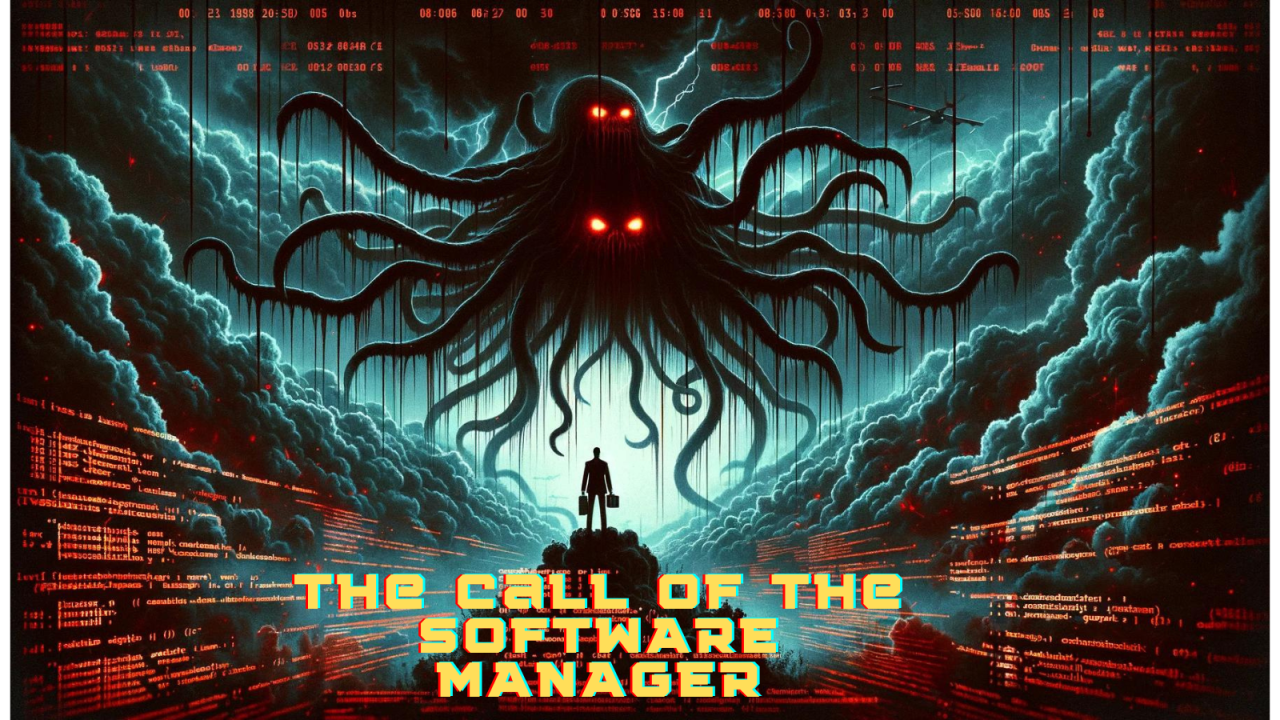
After waking up the next day, covered in a thick sweat, wondering what just transpired, you come to the realization that being a manager is completely different than what you expected. Forget shiny strategy presentations and buzzword-laden corporate memos – the true role of any development manager is to serve as high priest (or priestess) to our cosmic lord and savior, Cthulhu. This ancient, tentacled deity from the depths of R’lyeh cares nothing for your Gantt charts or meticulously crafted roadmaps. His sole intent is to unleash pure, unadulterated chaos upon any semblance of a plan. Picture a cosmic cat swatting at the yarn ball of your project timelines. That’s Cthulhu.
I’ve traversed the trenches of software development for longer than I care to admit. From nimble startups to lumbering corporate giants, Cthulhu’s delightful brand of disorder reigns supreme. You have three choices when faced with this existential terror:
-
Succumb. Curl into a whimpering fetal position while whispering apologies to your stakeholders. Await Cthulhu’s merciful oblivion.
-
Fight. Flail helplessly against the tide of madness, like a caffeinated squirrel facing down a semi-truck. Noble, perhaps, but ultimately futile.
-
Adapt. Learn to harness the swirling vortex of confusion. Become a zen master of mayhem, a guru of glitch, a… well, you get the point.
If utter annihilation isn’t on your career goals list, adaptation is the only sane choice. This isn’t about sacrificing your mental health on the altar of unrealistic deadlines. It’s about strategic survival. When you dedicate your early days as a development manager to stabilizing processes and forging a semblance of order, you carve out precious time: time to manage your team, time to strategize, and yes, even time to actually troubleshoot the inevitable tide of problems.
Consider this your survival guide to appeasing our cephalopodic lord while maintaining a shred of your sanity. We won’t delve into specific methodologies like Waterfall or Agile. Instead, we’ll focus on the meta, the foundational bedrock you need regardless of your team’s chosen dance with the devil of development.
Step 1: Embrace the Process
Think of a rickety wooden bridge spanning a chasm filled with ravenous piranhas – that’s the initial state of most development teams. Sure, work gets shipped, but it’s a miracle anyone survives the journey. Your first order of business is to trade that rickety bridge for a boringly reliable concrete overpass.

Processes are your salvation. They inject predictability into the pandemonium. Don’t panic; this doesn’t mean soul-sucking bureaucracy. Even a simple, well-defined workflow can significantly reduce daily friction.
But before you break out the celebratory mead (or emergency tentacle repellent, whichever your poison), let’s face a brutal truth: most development teams, left to their own devices, resemble a ramshackle bridge spanning a piranha-infested chasm. Sure, projects sometimes get delivered, but by the grace of caffeine and sheer willpower, not any semblance of order. Each day is spent constructing this rickety bridge anew, a monument to last-minute changes and frantic scrambling.
Here’s the kicker: the building materials are never consistent. One day, the lumber you scrounge might be suspiciously rotten, riddled with hidden bugs lurking just beneath the surface. The next, the piranhas might be replaced by something far more horrifying – merpeople from the Dagon depths, wielding tridents of ambiguity and spewing requirements that shift like desert sands.
Imagine the utter chaos. You spend your precious time hacking away at these ever-changing obstacles, leaving project deadlines a distant, shimmering mirage. By the time your team finally traverses this precarious bridge (or, more likely, gets devoured by a particularly ravenous school of flesh-eating catfish), the sense of accomplishment is overshadowed by the sheer exhaustion of the journey. Work, in this scenario, becomes a Sisyphean struggle, with each completed feature replaced by two new ones that materialize from the swirling mists of uncertainty.
This, my friend, is why process is your salvation. It’s the sturdy, reusable bridge you can rely on, day in and day out, no matter what Cthulhu throws your way. Now, don’t get hung up on aesthetics. Cthulhu, bless his eldritch heart, doesn’t care if your process is adorned with glitter and rainbows. He craves results, not Pinterest-worthy workflows. The key is functionality. It needs to be a bridge that gets your team across that chasm consistently, without sacrificing them to the horrors lurking beneath the surface.
Think of it this way: a well-defined process is like a set of blueprints for construction. It lays out the steps, the resources needed, and the potential pitfalls to avoid. No more guessing games about how to handle requests, prioritize tasks, or navigate the murky depths of requirement gathering. It’s a map through the labyrinth, a shield against the onslaught of chaos, and ultimately, the key to ensuring your team spends less time building bridges and more time building the actual project.
Consider the vanilla Software Development Life Cycle (SDLC), and go from there. Your team needs a shared understanding of these core phases:
-
The Gauntlet of Requests: How do work requests enter your world? A chaotic free-for-all leads to misaligned expectations and endless scope creep.
-
Triage & Approval: Who assesses incoming requests, decides on their validity, and prioritizes them?
-
Requirement Gathering: Here’s where the true madness often begins. How do you ensure everyone understands what the heck needs building?
-
The Sacred Code Forge: The actual development process. Enough said.
-
QA’s Fortress of Solitude: Quality assurance is your shield against releasing bug-riddled monstrosities to the world.
-
Deployment: The grand finale, where features face the judgment of your users.
Step 2: Become the Resource Wrangler with a Rusty (or Shiny) Tool

Now that you’ve established the bridge metaphor for process, let’s talk about the raw materials you need to get your team across that chasm. Here’s the truth, brave manager: resource management without a trusty tool is like wrestling a kraken with your bare hands. You might emerge victorious, but it’ll leave you bruised, battered, and questioning your sanity.
This trusty tool doesn’t have to be a mythical artifact forged in the fires of Mount Doom. It could be a simple whiteboard etched with erasable marker lines, a well-maintained (and possibly endangered) Excel spreadsheet, or a foray into the land of the Atlassian gods with a shiny new JIRA instance. The key lies in finding something reliable, something your entire team uses consistently.
-
Visibility is Key: Your tool should be a central nervous system, displaying your team’s capacity in all its glorious (or terrifying) detail. Who’s working on what? What skills do they possess? Are you perpetually understaffed, or are there individuals whose talents are underutilized? A good tool lets you see these things at a glance.
-
Communication Powerhouse: Imagine a world where everyone knows what everyone else is working on. A shared tool fosters communication and collaboration, reducing the risk of duplicated efforts and missed deadlines.
-
Historical Knowledge Bank: Remember that time Steve spent a week wrestling with a particularly nasty bug? A good tool can store that hard-won knowledge, preventing your team from re-inventing the wheel every time they encounter a familiar foe.
Now, the choice of tool is yours, my champion. Will you embrace the simplicity of a whiteboard, the nostalgia of a well-worn Excel file, or perhaps dive headfirst into the joyous world of Atlassian project management software? Remember, the most important factor isn’t the tool itself, but the picking something and then consistent usage by you and your team. Together, you’ll cobble together the semblance of a working resource management system that empowers informed decisions, prevents burnout, and keeps your sanity (somewhat) intact. After all, Cthulhu wouldn’t want you to be too unproductive, would he?
Step 3: Drive That Process with an Iron Fist (and a Touch of Malice)
Remember, our chaotic overlord, Cthulhu, adores throwing metaphorical goats (and possibly the occasional literal one) into your well-laid plans. Shiny new technologies, sudden scope changes, or the alluring whispers of switching to GoLang or Rust – these temptations will arise to lure your team off the righteous path of your process.
As development manager, your duty is to be the glorious, slightly malicious taskmaster. Yes, you care about your team’s happiness. Yes, you might sometimes even indulge in providing them with offerings of caffeine and snacks. But at the end of the day, the process must reign supreme, or risk descending into madness.
-
Process is Law: Your meticulously documented process shouldn’t be optional. It’s the law of the land, the constitution upon which your team’s survival depends. Every request, every change, every line of code should flow through its sacred channels.
-
Deviation is Heresy: When those goats of temptation start to prance around and lure your developers astray, crack that whip (perhaps metaphorically, unless HR signs off on a literal one). Remind your team that shortcuts today lead to blood sacrifices to Cthulhu tomorrow. Deviation disrupts the harmony of your process, leading to confusion and missed deadlines.
-
Documentation is a Shield: Incomplete documentation is a gaping hole in your defenses, an invitation for utter chaos. Enforce proper documentation with religious fervor. If a task isn’t documented, it might as well not exist. And if someone claims they’re “too busy to document,” gently remind them that Cthulhu is always happy to lighten their workload with a swift descent into insanity.
Now, don’t be a complete tyrant. Explain the why behind your unwavering devotion to the process. Show your team how it protects them from endless scope creep, unrealistic expectations, and late nights fueled by despair and Red Bull. By becoming the benevolent dictator of your process, you shield them (and yourself) from the unbridled chaos Cthulhu so gleefully delivers.
Step 4: Master the Dance of Change

“The only constant is change” – this phrase should be tattooed on the inside of your eyelids. In the world of software development, change is as inevitable as poorly formatted code and surprise outages. Your beautiful process isn’t worth the virtual paper it’s printed on if you can’t nimbly handle those curveballs Cthulhu loves launching at your face.
This is where formal change management comes in. Establish a clear, well-understood process for assessing the impact of changes. This includes evaluating potential risks, the effect on your timeline, and any budgetary concerns. Remember, every seemingly tiny change can have ripple effects that cause your project to drown in a sea of delays. Enforce your change management process like a nightclub bouncer tossing out unruly patrons.
Step 5: Navigate the Political Labyrinth
Ah, office politics. That delightful blend of whispers, backstabbing, and passive-aggressive emails about missing TPS reports. Sadly, technical prowess alone won’t save you here. Part of your job is to become a master diplomat, capable of navigating the treacherous currents of egos and agendas.
-
Thou Shalt Not Play Favorites: Even if those new-hire rockstars code like demigods, treat your entire team equitably. Favoritism breeds resentment faster than a poorly managed code repository breeds bugs.
-
Document EVERYTHING: When disputes inevitably arise (and they will), well-documented decisions and agreements will be your shields against the “he said, she said” blame game.
-
Know Your Stakeholders: Identify those who hold influence over your project, both official and unofficial. Build relationships, understand their priorities, and where possible, align your goals.
Step 6: The Art of Prioritization
You can’t do everything at once. Let that sink in. It’s a painful truth, but accepting it unlocks strategic power. The key is ruthlessly prioritizing tasks based on their true value to your project and the wider organization. There are many techniques out there, but here’s the core principle: stop prioritizing based on who yells the loudest.
Open communication with your team and stakeholders is your best weapon in this battle. A transparent backlog, where priorities are clear and updated regularly, empowers everyone to make better decisions. When Cthulhu comes bearing gifts of a dozen “urgent” feature requests, you and your team can present a unified front. Explain the trade-offs, the impact on existing timelines, and let stakeholders make informed choices.
It’s Not Easy, But It’s Worth It

Let’s not sugarcoat it: building a well-oiled development machine is like wrestling an octopus while juggling knives. It’s messy, it’s frustrating, and some days you’ll question your life choices. However, the payoff is immense. A team with reliable processes, clear communication, and a sense of stability isn’t merely more efficient; it’s more resilient. You’ll weather the inevitable storms that rock the software development world with a strength born of hard-won order. Your stakeholders will be happier, your team will be happier (or at least, less miserable), and you might even retain a sliver of sanity.
So, as you embark on your development management journey, remember: Cthulhu is always lurking in the shadows. But by focusing on building robust processes, managing resources wisely, and adapting gracefully to change, you can become not his hapless victim, but his begrudgingly tolerated herald. You will bring temporary order to his realm of madness, a respite from the inevitable descent into chaos. But listen closely, and you might still hear his whispers on the wind, a constant reminder that your sanity hangs by a thread, and the day Cthulhu decides to unravel it lies just beyond the horizon.

// COMMENTS